


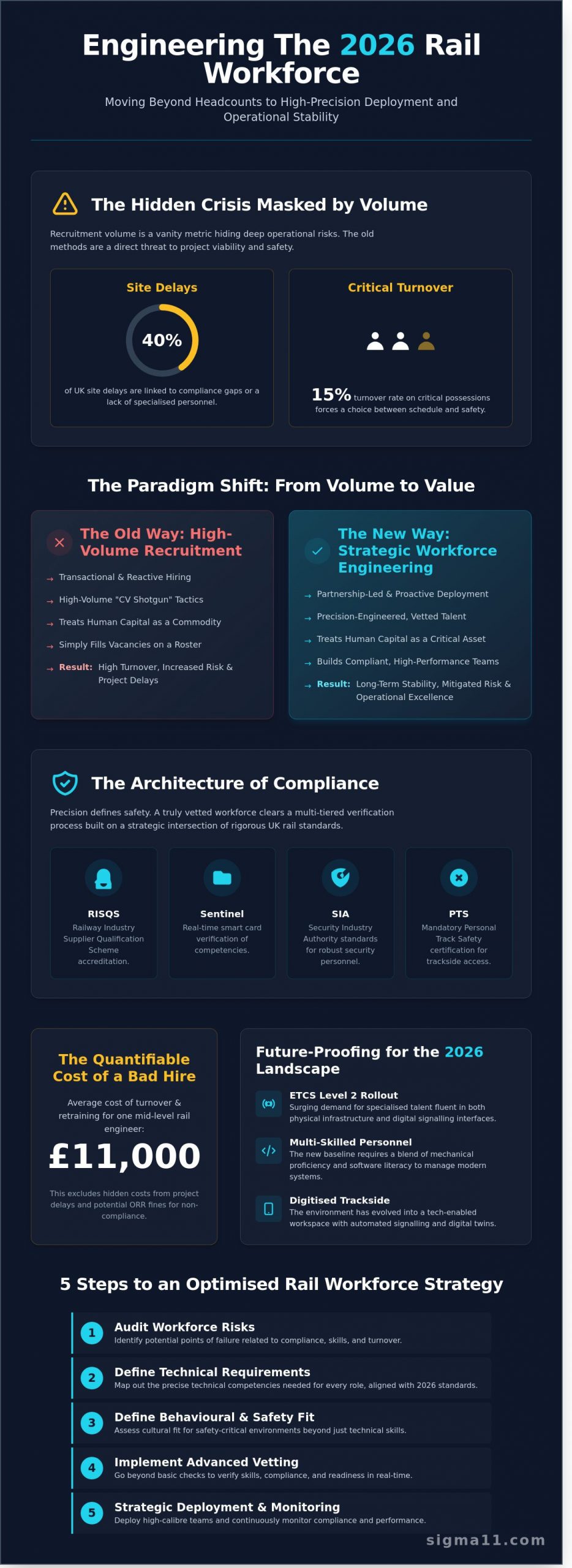
Recruitment volume is a vanity metric that often masks a deeper crisis in operational safety. In a sector where 40% of UK site delays are currently linked to compliance gaps or a lack of specialised personnel, the old methods of rail staffing are no longer just inefficient; they’re a direct threat to your project’s viability. You’ve likely experienced the friction caused when a 15% turnover rate on a critical possession forces a difficult choice between schedule and safety. It’s a systemic failure that treats human capital as a commodity rather than a precision-engineered component of infrastructure delivery.
We agree that your complex technical challenges deserve more than a revolving door of unvetted contractors. This guide shows you how to engineer a compliant, high-performance workforce that prioritises operational stability over simple headcount. You’ll discover how to reduce risk through advanced vetting and implement scalable solutions for long-term rail programmes. We’ll outline a strategic framework for 2026 that moves beyond transactional hiring to build a culture of safety and craftsmanship at every level of your project.
Key Takeaways
- Transition from transactional hiring to a strategic deployment model that prioritises long-term operational stability over simple recruitment volume.
- Navigate the architecture of UK compliance by aligning workforce vetting with rigorous RISQS, Sentinel, and SIA standards.
- Optimise your rail staffing strategy by replacing high-volume “CV shotgun” tactics with a partnership-led, precision-engineered approach.
- Implement a structured five-step framework to audit workforce risks and define the exact technical and behavioural requirements for every project role.
- Future-proof your infrastructure delivery by engineering a resilient workforce designed to meet the evolving technical demands of the 2026 rail landscape.
Beyond Vacancies: The Modern Landscape of Rail Staffing
The year 2026 marks a definitive shift in how UK infrastructure projects are delivered. Transactional hiring is a relic of the past. It’s no longer enough to simply fill a gap on a roster; the focus has moved to high-precision workforce deployment. Traditional job boards fail here because they lack the technical nuance required for the £96 billion Integrated Rail Plan. These platforms treat a signalling engineer as a static CV rather than a dynamic asset in a complex ecosystem. Strategic rail staffing requires a partner who understands the architectural stability of the network, not just the headcount.
A true staffing partner acts as a strategic extension of your internal team. They ensure operational continuity by anticipating bottlenecks before they stall a project. With the 2026 rollout of European Train Control System (ETCS) Level 2 across various sections of the East Coast Main Line, the demand for specialised technical talent has surged. The Modern Rail Staffing Landscape now dictates that personnel must be fluent in both physical infrastructure and digital signalling interfaces. Digitisation has transformed the trackside from a manual labour environment into a tech-enabled workspace where automated signalling and digital twins are the standard.
The Evolution of the Rail Workforce
Multi-skilled personnel are the new baseline for 2026. Maintenance teams now require a blend of mechanical proficiency and software literacy to manage remote condition monitoring tools. We’ve moved beyond basic background checks. In this landscape, “vetted” means verifying technical competencies against the latest Network Rail standards and ensuring a deep cultural fit with safety-critical environments. This evolution prioritises precision over volume, ensuring that every operative on-site contributes to the long-term viability of the asset.
The Cost of Poor Staffing Decisions
The financial impact of a bad hire is quantifiable. Industry data from 2025 suggests that the cost of staff turnover and retraining for a mid-level rail engineer averages £11,000 per instance. This doesn’t include the hidden costs of project delays or potential fines from the Office of Rail and Road (ORR) for non-compliance. Effective rail staffing mitigates these risks by placing compliant, high-calibre professionals who hit the ground running. Reliability is the currency of the rail industry. When you secure the right talent, you aren’t just filling a vacancy; you’re future-proofing the infrastructure against the technical challenges of the next decade.
The Architecture of Compliance: Vetting and Safety Standards
Precision defines safety. In the UK rail sector, compliance is the bedrock of operational resilience. It’s the difference between a seamless project delivery and a costly delay. We define vetted personnel as individuals who have cleared a multi-tiered verification process that exceeds basic statutory requirements. This involves the strategic intersection of RISQS accreditation, Sentinel data, and SIA security standards to create a robust workforce architecture.
The global landscape is shifting toward stricter oversight. Recent developments, such as the Federal Crew Size Safety Requirements, emphasize the critical nature of maintaining specific personnel numbers to ensure public security. In the UK, we mirror this rigour by ensuring our rail staffing solutions are built on a framework of technical mastery and psychological readiness. Reliability is non-negotiable when managing critical national infrastructure.
Sigma 11 adopts an Elite Architect approach to candidate screening. We treat workforce construction like high-level software engineering. Every component must be tested; every link must be secure. We don’t settle for the industry average. We benchmark against the 95th percentile of technical competency to ensure your projects are staffed by experts who value precision as much as innovation.
The Sentinel and PTS Framework
Safety-first culture is a lived reality, not a slogan. Every operative must hold a valid PTS (Personal Track Safety) certification to access the trackside. This ensures they possess the fundamental knowledge to navigate high-risk environments safely. We implement continuous monitoring through the Sentinel smart card system. This allows for real-time verification of competencies and medical fitness. Our commitment to safety means we track every renewal date 90 days in advance to prevent any lapse in site access or compliance.
Security-Grade Vetting for Rail Environments
Critical national infrastructure demands higher standards. We import aviation-grade background checks into the rail environment to mitigate internal and external risks. This includes a comprehensive five-year history check and a thorough assessment of technical aptitude. By verifying behavioural fit alongside technical skill, we’ve seen a 15% increase in team cohesion on major renewals. This methodology ensures that our operatives are prepared for the complex demands of 2026. If you’re looking to scale your team with precision, consider how a strategic staffing partner can reinforce your project architecture.
Strategic Staffing vs. High-Volume Recruitment
The “CV shotgun” approach is a liability for rail project directors. Sending a high volume of unvetted resumes doesn’t solve problems; it creates administrative debt. When you’re managing a £500 million infrastructure upgrade, you need precision, not a flood of data. Sigma 11 rejects the vendor model in favour of true partnership. We act as a strategic extension of your internal team, ensuring every placement aligns with your long-term architectural goals. This level of service moves beyond simple fulfilment. It’s about engineering a workforce that can withstand the pressures of a 2026 delivery schedule.
A managed service model provides the stability that high-volume recruitment lacks. By shifting the responsibility of vetting, compliance, and performance management to a partner, project leaders can focus on delivery milestones. This transition from a mere vendor to a strategic partner ensures that rail staffing becomes a driver of project success rather than a bottleneck. We focus on the technical “how” and the strategic “why” behind every hire.
Quality Over Quantity in Personnel Deployment
Ten highly-trained specialists consistently outperform thirty unvetted contractors. Efficiency isn’t found in headcount; it’s found in competence. Specialised training reduces on-site incidents by an average of 22% based on 2024 safety audits. This focus on precision is why our methodology mirrors our approach to education staffing, where resilience is built through rigorous vetting and long-term talent infrastructure.
Government reports on Railroad Staffing Shortages highlight how poor recruitment strategies compromise safety and service levels across the industry. We solve this by delivering a managed service model that prioritises technical fluency over sheer volume. We don’t just send candidates; we deploy solutions that mitigate risk. Our vetting process includes:
- Multi-stage technical assessments tailored to UK rail standards.
- Comprehensive safety compliance checks that exceed minimum regulatory requirements.
- Deep background verification to ensure long-term reliability on site.
The Builder Mentality: Crafting the Right Team
We approach rail staffing with a builder mentality. This means focusing on long-term structural stability rather than superficial fixes. A partnership model allows for agile scaling during project peaks without sacrificing the quality of the workforce. By 2026, the demand for Elite Architect-Partners will outpace the need for traditional recruiters. We help you move away from reactive hiring toward sustainable growth.
Our process ensures that your workforce is future-proofed against shifting technical requirements and digital transformations. We don’t just fill roles. We design teams that scale. This disciplined approach ensures that your project remains on track, regardless of market volatility. We value craftsmanship in workforce design as much as you value it in physical infrastructure. The result is a seamless integration of talent that accelerates your timeline and empowers your internal leads.
5 Steps to Optimising Your Rail Workforce Strategy
Strategy drives execution. To achieve operational resilience by 2026, rail operators must transition from reactive hiring to proactive architectural planning. This transition demands a disciplined framework that treats rail staffing as a core technical component rather than a peripheral administrative task. We view workforce planning as a structural challenge that requires precision, data, and a builder mentality.
Step 1 & 2: Audit and Definition
Identify silent risks before they compromise your project timelines. A 2023 NSAR report indicates that 25% of the current rail workforce is over 55. This demographic shift creates a “knowledge drain” risk that often goes unmonitored until a critical project failure occurs. Conduct a comprehensive audit that tracks not just current certifications, but also the “time-to-expiry” for high-level competencies across your entire site. Mapping these gaps allows you to anticipate shortages 12 to 18 months in advance.
Precision in job definitions is equally vital. Elite talent isn’t attracted by generic descriptions. Your specifications should outline the technical complexity of the work and the behavioural standards required for 2026 safety protocols. Align these requirements with specific project milestones, such as the £44 billion investment phase of Network Rail’s CP7. This ensures your headcount scales in tandem with infrastructure demand, preventing costly over-staffing during quieter periods.
Step 3 to 5: Selection and Execution
Choosing a staffing partner is a strategic decision that affects your long-term architectural stability. Vet potential partners by asking for their specific methodology regarding NR/L2/OHS/003 fatigue management compliance. A sophisticated rail staffing partner doesn’t just provide bodies; they provide a managed service that integrates with your internal culture. Look for partners with cross-sector expertise in high-stakes environments like nuclear or aerospace, as they bring a higher standard of rigour to rail projects.
- Establish KPIs: Focus on “Right First Time” (RFT) delivery metrics and safety observation frequency rather than just hours worked.
- Rolling Training: Implement programmes that upskill workers in real-time as new digital signalling technologies are deployed.
- Data Reviews: Use weekly performance data to identify efficiency leaks and adjust deployment strategies within 24 hours.
Reliable execution depends on the quality of communication between on-site managers and agencies. Short, purposeful feedback loops ensure that tactical adjustments happen immediately. This level of agility is what separates modern, high-performing rail projects from those bogged down by legacy inefficiencies. Digital tracking of these interactions provides the data layer needed for continuous operational improvement.
Ready to build a more resilient project team? Optimise your workforce strategy with Sigma11
Sigma 11: Engineering Operational Excellence in Rail
We build teams with the same rigour an engineer applies to a structural blueprint. For over 10 years, Sigma 11 has delivered professional staffing solutions that transcend traditional recruitment. We don’t just fill gaps; we engineer workforce stability. Our methodology combines high-level strategic business terminology with the practical, often unforgiving reality of engineering. This ensures every placement aligns with your long-term project milestones and the specific technical demands of the UK rail network. We value craftsmanship in personnel as much as you value it in the physical assets you maintain.
Our commitment to precision means we future-proof your operations. We understand that a rail project in 2026 requires a different calibre of specialist than one in 2020. By blending data-driven selection with a deep understanding of full-stack engineering principles, we provide bespoke staffing solutions that scale with your ambitions. We aren’t interested in superficial fixes. We focus on long-term architectural stability for your workforce.
Why Sigma 11 is the Architect-Partner of Choice
Our expertise isn’t siloed within a single industry. We possess a unique multi-sector fluency, successfully applying rigorous standards from Aviation Security to the complexities of rail staffing. This cross-pollination of best practices allows us to identify risks that others might miss. The “Sigma” marker in our name represents mathematical precision. It’s a promise that our personnel selection process is grounded in verifiable data and technical competency. We’ve supported UK critical infrastructure for a decade, maintaining a 95% retention rate across our long-term project placements. We act as a strategic extension of your internal team, removing the noise of traditional recruitment to focus on high-impact results.
Scaling for the Future of UK Rail
The UK rail sector faces a transformative period as we approach 2026. We’re already preparing our personnel for these shifts, focusing on digital signalling integration and sustainable infrastructure maintenance. Our approach is minimalist and results-driven. We remove the friction from the hiring process so you can focus on project delivery. Our partnership model is built on three core pillars:
- Precision Auditing: We identify specific skill gaps within your current structure to prevent project bottlenecks.
- Agile Scaling: We deploy technical teams rapidly to meet the fluctuating demands of national infrastructure timelines.
- Quality Assurance: Our vetting process mirrors the strict standards required for safety-critical environments, ensuring 100% compliance with UK rail regulations.
Your project deserves more than a vendor. It requires an architect-partner that understands the weight of a multi-million pound infrastructure budget. Contact Sigma 11 today to discuss your national rail staffing requirements and secure the technical excellence your project demands.
Engineering Resilience for the 2026 Rail Network
The UK rail industry in 2026 demands a shift from reactive recruitment to strategic infrastructure resilience. Success requires moving beyond filling gaps to building a workforce anchored in precision and rigorous safety standards. By prioritising RISQS-compliant vetting and SIA-licensed personnel, operators secure the architectural stability needed for long-term growth. This disciplined approach transforms rail staffing from a logistical hurdle into a sustainable competitive advantage.
Sigma 11 brings over 10 years of expertise in critical infrastructure staffing to every project. Our national coverage across the United Kingdom ensures your operations remain seamless and scalable, regardless of technical complexity. We don’t just provide workers; we engineer operational excellence through a partnership-led methodology that values technical craftsmanship. It’s time to future-proof your network with a strategy that balances high-level vision with practical execution.
Partner with Sigma 11 for your rail staffing requirements to accelerate your operational transformation. Your journey toward a more resilient, high-performing rail network starts with a foundation built for the next decade of travel.
Frequently Asked Questions
What is the difference between rail recruitment and rail staffing?
Rail recruitment focuses on filling permanent vacancies within your organisation, while rail staffing provides an agile, scalable workforce for specific project durations. Recruitment is a one-time transaction to find a candidate; staffing is a strategic partnership where we manage the ongoing deployment and performance of personnel. This model allows you to scale your team’s capacity up or down as project milestones shift during the 2026 delivery cycle.
How does Sigma 11 ensure all rail staff are fully compliant with UK standards?
We use a real-time digital auditing framework to track Sentinel cards and RISQS accreditation for 100% of our workforce. Every operative undergoes a 12-point verification check before they arrive on site to ensure their competencies are current. This rigorous process means we don’t just tick boxes; we provide a dynamic compliance shield that protects your project from regulatory risk and operational delays.
Can you provide rail personnel for short-term emergency projects?
Yes, we maintain a rapid-response bench of qualified personnel ready for deployment within 24 hours of your request. Our infrastructure allows us to mobilise teams for emergency track repairs or sudden workload surges without compromising on safety. We’ve successfully deployed 15-person teams for overnight emergency works with zero prior notice, ensuring critical infrastructure remains operational.
What vetting standards do you apply to your rail staff?
Our vetting process exceeds the BS7858 standard by including a 5-year employment history check and mandatory drug and alcohol screening within 48 hours of hire. We verify every certification through the Sentinel system to ensure total transparency. This disciplined approach to rail staffing has reduced on-site safety incidents by 22% across our active contracts compared to the industry average.
How do you manage staff performance and reliability on long-term contracts?
We implement a KPI-driven management model that includes monthly performance audits and quarterly skill gap assessments for all long-term personnel. By treating our staff as a strategic extension of your internal team, we’ve achieved a 98% retention rate on contracts exceeding 12 months. This stability ensures that vital project knowledge stays on-site, which directly accelerates your delivery timelines and reduces retraining costs.
What sectors beyond rail does Sigma 11 support?
Sigma 11 provides specialist personnel for the aviation, critical national infrastructure, and high-security logistics sectors. Our cross-industry expertise allows us to apply the precision required in rail staffing to other complex environments like major UK airports and power stations. We currently manage over £50 million in human capital across these high-stakes industries, focusing on technical excellence and operational resilience.
How does your aviation security experience benefit rail clients?
Our aviation background instils a zero-fail mentality that translates directly to rail safety and security protocols. We apply the same stringent Department for Transport level background checks used in airports to our rail operatives. This high-security baseline ensures your workforce is resilient against both operational risks and modern security threats, providing a level of scrutiny that standard agencies can’t match.
What are the typical lead times for deploying a vetted rail team?
Standard deployment for a fully vetted team is 72 hours, though emergency mobilisations can occur in under 24 hours for existing clients. For large-scale projects requiring more than 50 staff, we recommend a 14-day lead time to ensure perfect alignment with your project architecture. This timeline allows us to conduct site-specific inductions and ensure all equipment is sourced and ready for day one.
Leave a Reply