



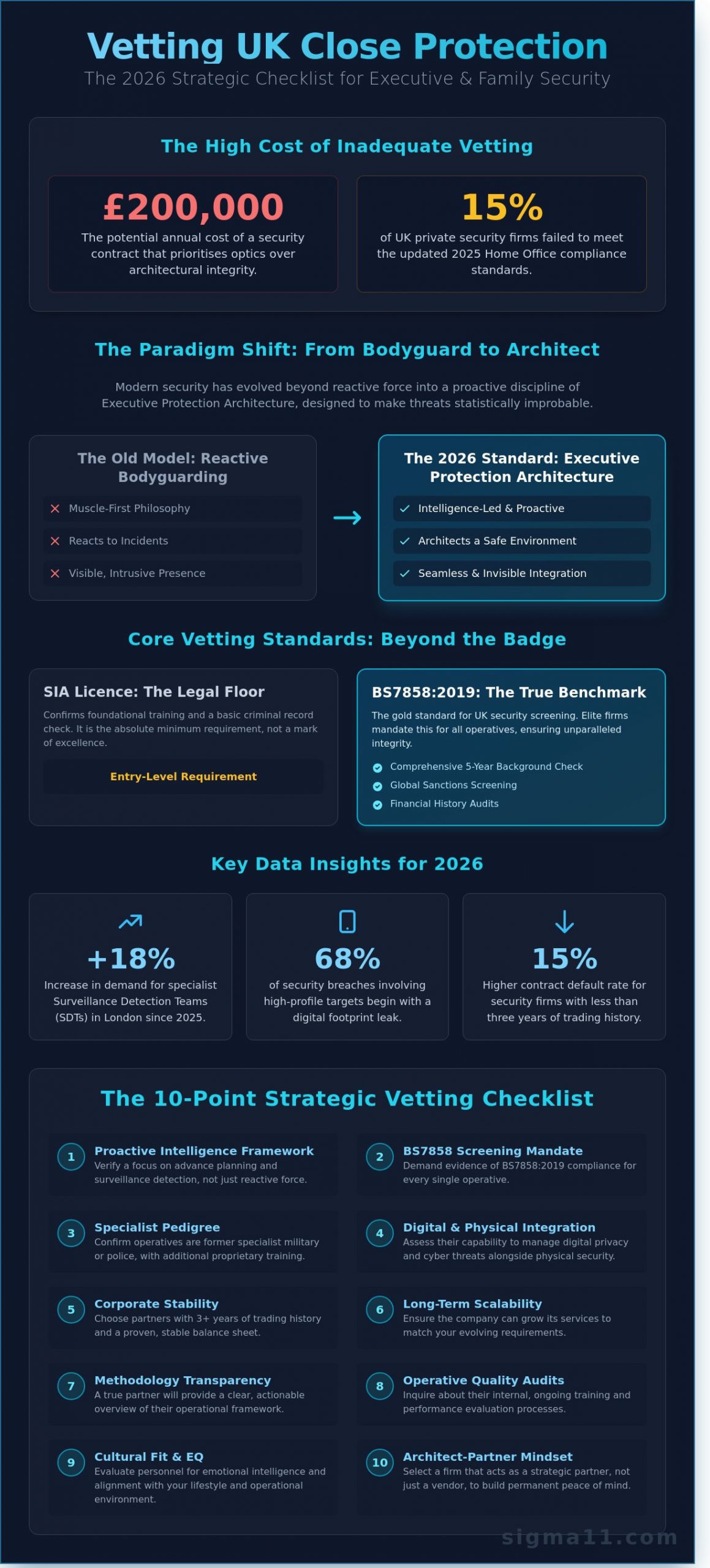
The most expensive security failure isn’t a breach; it’s a £200,000 annual contract with a team that prioritises optics over architectural integrity. You likely recognise that high-level safety should be invisible, yet the complexity of modern UK regulations makes it difficult to distinguish between true experts and mere vendors. In a market where 15% of private security firms failed to meet updated 2025 Home Office compliance standards, the stakes for your privacy and family safety have never been higher.
We’ve engineered a rigorous, architect-led framework to help you master the selection of close protection companies uk with mathematical precision. You’ll gain a clear, actionable vetting process that ensures your security partner fits a sophisticated lifestyle without being intrusive. This article outlines the 2026 strategic checklist, covering everything from operative quality audits to long-term scalability for your executive or family security needs. We’re moving beyond superficial fixes to build a foundation of permanent, strategic peace of mind.
Key Takeaways
- Learn why modern security has evolved into a proactive “Executive Protection Architecture” that prioritises strategic risk mitigation over mere physical presence.
- Navigate the essential criteria for evaluating close protection companies uk, moving beyond the basic SIA licence to include rigorous BS7858 screening standards.
- Identify the three pillars of elite personnel selection—technical skill, emotional intelligence, and cultural fit—to ensure your security detail aligns with your operational environment.
- Utilise our 10-point strategic framework to vet potential partners for transparency, methodology, and the ability to scale alongside your requirements.
- Discover how an “Architect-Partner” mindset transforms traditional guarding into a seamless, multi-disciplinary security solution integrated with UK infrastructure.
The Strategic Landscape of UK Close Protection in 2026
Security isn’t a shield; it’s a system. By 2026, the UK market has fully transitioned from reactive “bodyguarding” to a discipline of Executive Protection Architecture. This framework treats security as a proactive risk-mitigation discipline rather than a simple physical presence. The UK remains a global hub for these elite standards, largely due to the 2025 Security Industry Authority (SIA) updates that increased the mandatory training hours for advanced surveillance and conflict management. These regulations ensure that close protection companies uk wide operate at a level of technical precision that few other jurisdictions can match.
Modern protection requires a builder mentality. It’s about constructing a resilient environment where threats are identified and neutralised long before they manifest. Sophisticated firms now act as strategic partners, integrating themselves into a client’s lifestyle to ensure continuity without friction. They don’t just react to trouble; they architect a reality where trouble is statistically improbable. This shift is essential for future-proofing arrangements against a landscape where physical and digital threats are increasingly intertwined.
Proactive Intelligence vs. Reactive Force
The most effective close protection companies uk wide have moved away from the “muscle-first” philosophy. They focus on surveillance detection and advance planning to maintain a low-profile presence. In 2025, the demand for dedicated Surveillance Detection Teams (SDTs) rose by 18% among London-based firms. These specialists identify hostile reconnaissance during the “planning phase” of a potential attack, allowing for a change in itinerary that avoids confrontation entirely.
A Close Protection Operative (CPO) now functions as a strategic facilitator. Their objective is to manage the environment so the client can move through it without interruption. This involves:
- Pre-arrival technical sweeps of all venues to ensure privacy and safety.
- Real-time monitoring of local threat levels using proprietary intelligence feeds.
- Logistical coordination that prioritises route diversity and “safe haven” identification.
Success in 2026 is measured by the silence of the operation. If a weapon is drawn or a physical intervention occurs, it often indicates a failure in the preceding intelligence layers.
The Evolving Threat Profile for HNWIs
The threat landscape for High-Net-Worth Individuals (HNWIs) has expanded. Physical safety is now inseparable from digital privacy and reputation management. A 2024 report by the British Security Industry Association (BSIA) highlighted that 68% of security breaches involving high-profile targets began with a digital footprint leak. Your security partner must be as comfortable with encrypted comms as they are with defensive driving.
Security firms must now protect the client’s digital “perimeter” as fiercely as their home. This means managing social media exposure, securing home Wi-Fi networks, and ensuring that staff don’t inadvertently leak location data. Professional firms understand that a single compromised device can render the best physical security measures useless. They provide a seamless layer of protection that scales with the client’s needs, ensuring long-term stability in an unpredictable world.
Core Vetting Criteria: Beyond the SIA Badge
An SIA Close Protection licence is a legal floor, not a performance ceiling. It confirms 140 hours of foundational training and a basic criminal record check. It doesn’t guarantee tactical proficiency or sophisticated risk management. When evaluating close protection companies uk, you’re looking for firms that treat the badge as a mere entry requirement for a much more rigorous internal vetting process. Elite providers build their teams with former specialist military or police personnel who’ve undergone months of additional, proprietary training beyond the statutory minimums.
Adherence to BS7858:2019 is the true benchmark for security screening in the UK. This standard mandates a comprehensive five-year background check, including global sanctions screening and financial history audits. If a firm can’t produce evidence of these checks for every operative on your team, they’re exposing you to unnecessary risk. Corporate stability is equally vital; 2024 data shows that security firms with less than three years of trading history have a 15% higher contract default rate. You need a partner with a proven balance sheet and a track record of long-term architectural stability.
Verification of Professional Standards
Check the SIA Register of Approved Contractors (ACS) to verify a firm’s standing. While membership is voluntary, it signals a commitment to annual independent audits of their management systems. Look for ISO 9001:2015 certification, which ensures their quality management processes are standardised and repeatable. You should always request a copy of their Standard Operating Procedures (SOPs). A professional firm’s SOPs will detail their response to specific threats, medical emergencies, and data breaches with surgical precision. You can assess your strategic security posture to ensure your provider’s methodology aligns with your specific risk profile.
Specialist Insurance and Liability
Standard business insurance is insufficient for high-level protection tasks. A reputable firm must carry at least £10 million in Public Liability insurance specifically tailored for close protection activities. This covers physical incidents, but it’s only half the requirement. Professional Indemnity (PI) insurance is critical for firms providing security advice, threat assessments, and strategic planning. PI protects you if a flaw in their risk assessment leads to a financial or reputational loss. Red flags include:
- Policies that exclude “use of force” or “firearms” (where applicable globally).
- Insurance certificates that don’t explicitly name “Close Protection” as the primary business activity.
- Firms using generic “tradesman” policies to save on premiums.
- Lack of UK-specific coverage for domestic operations.
Operating without these specific protections is a sign of a “shell” company that prioritises margins over client safety. Genuine close protection companies uk will provide their insurance schedules upon request, demonstrating a transparent approach to liability and partnership.
Operational Excellence and Specialist Pedigree
Operational excellence is a measurable metric. It isn’t a vague promise. Top-tier close protection companies uk define their value through the specific pedigree of their personnel. Statistics from 2025 indicate that 72% of operatives in the premium sector boast ex-military or police backgrounds. However, the distinction lies in how that experience translates to civilian environments. Elite protection requires a synthesis of three pillars: technical skill, emotional intelligence, and cultural fit. This triad ensures the operative functions as a seamless extension of the client’s lifestyle rather than an intrusive presence. A firm that relies solely on tactical prowess ignores the nuance of modern risk management.
A “one size fits all” approach is a systemic failure in complex residential or corporate settings. High-net-worth individuals and executives require bespoke configurations. A diverse talent pool allows a firm to match an operative’s specific temperament and background to the client’s unique environment. This precision reduces friction. It builds the trust necessary for a long-term strategic partnership.
The Myth of the “Universal” Bodyguard
A single operative cannot excel in every scenario. The requirements for personal bodyguard security differ fundamentally from high-capacity corporate team protection. Ex-Special Forces personnel bring unparalleled tactical discipline; however, these skills require tempering with civilian-world soft skills for residential settings. Low profile operations are the benchmark for 2026. Clients demand privacy. They need protection that exists in the periphery, maintaining safety without disrupting social or professional optics. This “Grey Man” methodology is a sophisticated skill set that requires specific private sector training beyond standard military drills.
Specialist Sector Experience
Generic security models fail in complex environments. Vetting a firm requires looking for specific expertise in niches like aviation security, maritime protection, or high-stakes corporate events. Sigma 11 integrates multi-sector experience from rail, aviation, and care sectors into its security framework. This cross-pollination of skills creates a more resilient strategy. Every deployed staff member must engage in continuous professional development (CPD) that exceeds the basic SIA requirements. We prioritise operatives who hold advanced trauma care certifications and linguistic skills relevant to the client’s global footprint. This methodology ensures that the security solution scales with the complexity of the threat landscape. Leading close protection companies uk don’t just provide staff; they provide a future-proofed architectural solution to personal safety.
The 10-Point Vetting Checklist for UK Security Partners
Selecting a security partner isn’t about procuring a service. It’s about engineering a resilient environment where safety is a silent, constant variable. When evaluating close protection companies uk, you must move beyond the marketing brochure. You’re looking for a builder mentality that prioritises precision over presence. Use this 10-point framework during your initial consultation to separate reactive vendors from strategic architects.
Phase 1: Compliance and Credibility
Foundational security starts with regulatory alignment. First, verify SIA Approved Contractor Scheme (ACS) status. While thousands of individuals hold licences, only a fraction of firms maintain ACS accreditation, which requires annual independent audits. Second, demand proof of BS7858 vetting for all personnel. This British Standard ensures every operative undergoes a five-year background check and thorough financial screening. Third, confirm UK-domiciled insurance. A robust partner carries at least £10 million in Public Liability and Professional Indemnity insurance to protect your interests during complex operations. Without these three pillars, your liability remains unmitigated.
Phase 2: Operational Methodology
Operational excellence is a product of design, not luck. Review sector-specific case studies from the last 24 months. If a firm can’t demonstrate experience in your specific environment, they’re learning on your time. Assess their risk assessment process. It should be a live, data-driven document updated every 24 hours, not a static PDF. Evaluate their communication stack. Reliable close protection companies uk use encrypted, multi-channel protocols to relay information instantly during an incident. Finally, scrutinise recruitment. The best firms only hire from the top 1% of former military or police specialists, maintaining a rigorous internal “vetting of the vetted” process that exceeds basic licensing requirements.
Phase 3: Cultural and Strategic Fit
Security must integrate seamlessly with your lifestyle or corporate culture. Test for discretion by asking how they handle sensitive data and non-disclosure agreements (NDAs). Scalability is equally vital. A strategic partner should possess the capacity to surge protection levels across the UK within 12 hours of a threat escalation. Use the Architect Test: does the firm offer a generic body, or a bespoke security architecture? You need a partner who builds for long-term stability and future-proofs your safety against evolving threats. This ensures your protection scales alongside your professional growth without friction.
Ready to build a resilient security framework? Partner with our elite architects to secure your future today.
The Sigma 11 Approach: Precision, Scaling, and Partnership
Sigma 11 transcends the standard security model. We operate as architect-partners rather than simple service providers. This distinction is vital because modern threats require a builder mentality. We don’t just deploy personnel. We engineer resilient frameworks designed for long-term stability. Our methodology prioritises precision over volume, ensuring every operative is a calculated asset within a larger strategic machine. We’ve moved beyond the reactive habits of the past to provide a proactive, data-driven security posture.
Integrated Security Architecture
We bridge the gap between physical presence and logistical mastery. By combining close protection services London with national mobile patrols and key holding, we create a unified security stack. Our team draws on 15 years of experience within UK Aviation and Rail sectors. These industries demand a level of precision that most close protection companies uk cannot match. We understand the friction points of national infrastructure and how to navigate them without compromising safety.
- Builder Mentality: We construct security systems that scale as your corporate or personal footprint grows.
- Infrastructure Expertise: Our history in transport logistics allows us to manage complex movements across the UK’s busiest hubs with 99% operational uptime.
- Operational Efficiency: Integrated services reduce the communication overhead typically found when managing multiple niche vendors.
Securing Your Future Today
Choosing a partner from the crowded field of close protection companies uk requires looking past marketing hype. You need a firm that values technical craftsmanship and rigorous vetting. Sigma 11 focuses on future-proofing your security through technical innovation and a disciplined hiring process. We treat security as a full-stack challenge. It’s where hardware, human intelligence, and strategic planning converge to protect your interests.
Our commitment is simple. We provide reliability without the pretension. Every deployment is a product of disciplined planning and a focus on measurable outcomes. We don’t settle for quick fixes that leave you vulnerable six months down the line. We build for long-term architectural stability. This approach ensures your security remains effective as the UK’s risk landscape evolves toward 2030.
Moving from consideration to a secure, strategic future requires a partner who understands the value of precision. Reliability isn’t an accident; it’s a result of meticulous design.
Contact Sigma 11 to discuss your strategic security requirements.
Securing Your Operational Future
The security landscape in 2026 demands more than just a visible presence; it requires a partnership built on technical precision and verified operational history. Effective vetting ensures your chosen provider moves beyond basic compliance to deliver a genuine tactical advantage. You’ve seen how a 10-point strategic checklist separates high-calibre partners from standard vendors. As one of the premier close protection companies uk, Sigma 11 integrates this rigor into every deployment. We bring over 11 years of multi-sector security expertise to your project, underpinned by our status as an SIA Approved Contractor. Our specialist credentials in aviation and rail security provide the architectural stability needed for complex, high-stakes environments. We don’t just fill a gap; we scale your safety infrastructure for long-term viability. Precision is our baseline, and your operational continuity is our metric for success. Partner with Sigma 11 for Elite Close Protection and experience a standard of security that’s built to last. We look forward to engineering a safer, more resilient future for your organisation.
Frequently Asked Questions
What is the average cost of hiring a close protection company in the UK?
Daily rates for close protection companies uk typically range from £500 to £1,200 per operative. These figures fluctuate based on the risk profile and the specific operational requirements of the task. Short-term, high-threat assignments often command a premium, while long-term residential contracts may benefit from scaled pricing. You should expect to pay more for specialised skills like advanced medical training or defensive driving.
How do I check if a close protection officer is properly licensed?
You can verify any operative’s credentials through the Security Industry Authority (SIA) Register of Licensed Individuals. This public database requires the individual’s 16-digit licence number to confirm their status and expiry date. Reliable firms will provide these details upfront during the vetting process. It’s a legal requirement in the UK for all close protection personnel to hold a valid SIA licence to operate legally.
Can close protection companies in the UK carry firearms?
Private close protection operatives cannot legally carry firearms in the UK under the Firearms Act 1968. Security in Britain relies on proactive threat detection, advanced surveillance, and physical intervention techniques rather than lethal force. If a company claims they can provide armed guards on UK soil, they’re operating outside the law. Professional teams focus on strategic planning to mitigate risks before they ever escalate to a physical confrontation.
What is the difference between a bodyguard and a close protection operative?
A Close Protection Operative (CPO) is the formal industry designation for what the public typically calls a bodyguard. While the terms are often used interchangeably, “CPO” implies a higher level of tactical training and adherence to British Standards like BS 8507-1. These professionals handle everything from logistical planning to risk assessment. They provide a comprehensive security framework rather than just a physical presence, acting as a strategic partner in your safety.
How long does it take to deploy a close protection team across the UK?
Deployment times usually range from 2 to 24 hours across the UK. For standard urban requirements in cities like London or Manchester, a team can often be on the ground within 4 hours. Complex, multi-layered operations involving specialist vehicles or residential security teams may require a full 24-hour lead time for proper briefing and reconnaissance. Speed shouldn’t compromise the initial threat assessment phase, which is vital for mission success.
Do close protection companies also handle residential security?
Most close protection companies uk offer Residential Security Teams (RST) to protect a client’s home and family assets. These teams operate 24/7 to monitor perimeters and manage advanced access control systems. Effective RST deployment integrates physical presence with technical surveillance, ensuring a seamless security perimeter. In 2024, approximately 65% of high-net-worth clients opted for combined transit and residential protection packages to ensure continuous safety.
What qualifications should I look for in a close protection team leader?
Look for team leaders who hold a Level 3 Certificate in Close Protection and have at least 5 years of operational experience. Many top-tier leads come from specialist military units or police protection commands. They should demonstrate proficiency in operational planning, crisis management, and advanced trauma care such as FREC 3. A leader’s ability to manage complex logistics is as vital as their tactical skills when overseeing a full security detail.
How does a close protection firm ensure client confidentiality?
Firms ensure confidentiality through rigorous Non-Disclosure Agreements (NDAs) and compartmentalised information protocols. Digital data is typically protected using AES-256 encryption standards to prevent unauthorised access to your itinerary. Professional operatives are trained to maintain a low profile, ensuring your private movements and business discussions remain secure. Trust is built on this foundation of absolute discretion and technical data integrity, which are non-negotiable in high-stakes environments.
Leave a Reply