



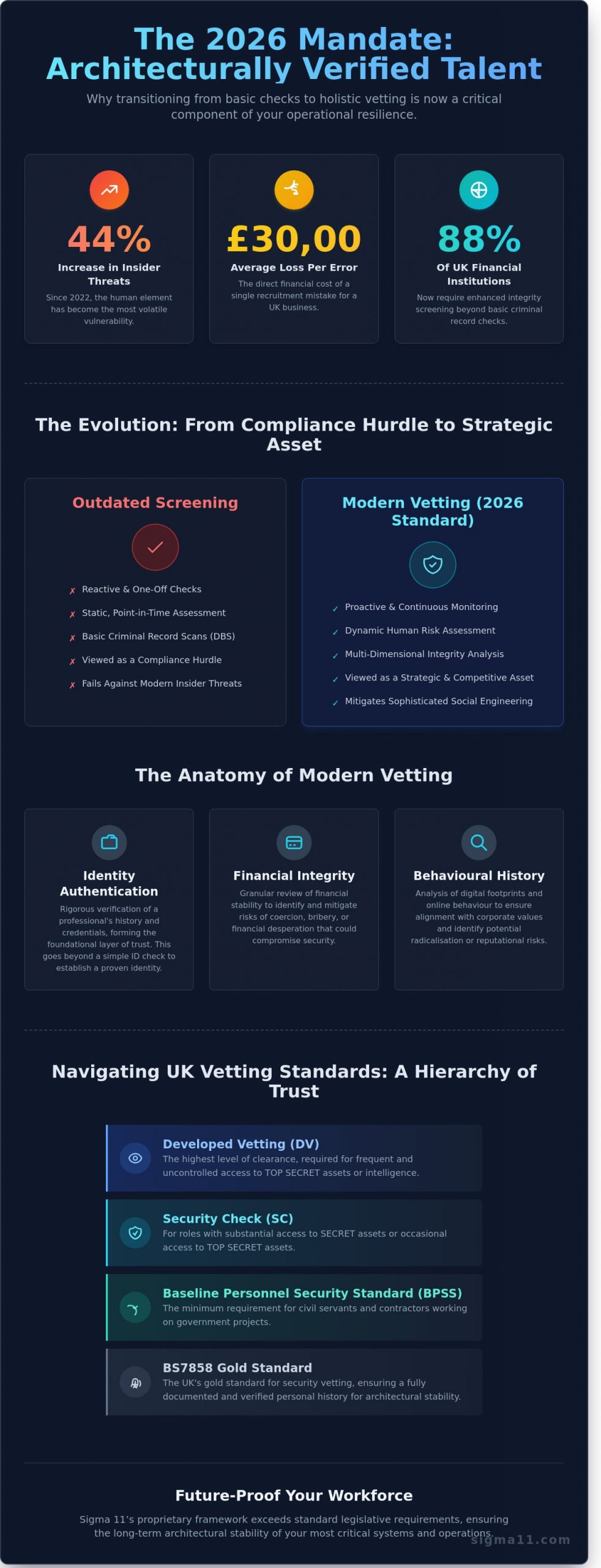
By 2026, a single oversight in your recruitment pipeline won’t just be a HR headache; it’ll be a catastrophic breach of your operational resilience. The reality is that insider threats have increased by 44% since 2022, making the human element your most volatile vulnerability. You’ve likely felt the pressure of tightening UK compliance standards and the rising costs of unverified staff, where a single recruitment error now averages a £30,000 loss for British businesses. Securing high-calibre vetted personnel isn’t just a compliance box to tick; it’s a strategic necessity for any organisation focused on long-term stability and precise execution.
This guide explores how the evolution of staff verification is transforming risk management and why certified experts are the fundamental cornerstone of business stability in 2026. You’ll discover a clear framework for navigating UK vetting levels and gain the justification needed to invest in higher-tier verification. We’re moving beyond simple background checks to a strategic model of personnel security that empowers your long-term growth and future-proofs your architecture against the complexities of a shifting regulatory landscape.
Key Takeaways
- Redefine your workforce as architecturally verified talent by transitioning from basic background checks to holistic integrity assessments for the 2026 risk landscape.
- Implement a “Product-Led Vetting” strategy to accelerate rapid scaling and enhance service quality through a pre-verified talent pool.
- Quantify the strategic value of vetted personnel by comparing proactive verification costs against the catastrophic financial and reputational impact of a security breach.
- Master sector-specific standards, particularly within education staffing, to build a resilient talent infrastructure that mitigates modern liability risks.
- Future-proof your operations with Sigma 11’s proprietary framework that exceeds standard legislative requirements to ensure long-term architectural stability.
Defining Vetted Personnel in the 2026 Risk Landscape
Precision is the foundation of operational resilience. In the 2026 risk environment, we define vetted personnel as architecturally verified talent. This isn’t a passive status or a simple badge of entry. It represents a rigorous, multi-dimensional verification process where a professional’s history, ethics, and technical capabilities are mapped directly against the resilience requirements of the systems they manage. The shift from reactive background checks to proactive integrity assessments is now complete. Organisations no longer view vetting as a human resources hurdle, but as a core component of their security architecture.
The 2026 landscape demands this evolution. Standard checks that satisfied requirements in 2022 are insufficient against modern threats. Data from 2025 indicates that 88% of UK financial institutions now require enhanced integrity screening that goes beyond criminal record visibility. This is a non-negotiable requirement in sectors such as critical national infrastructure, aerospace, and high-growth fintech. We build systems to scale, and those systems are only as stable as the individuals holding the keys to the kingdom.
The Anatomy of Modern Vetting
Modern verification rests on three pillars: identity authentication, financial integrity, and behavioural history. While a basic Security clearance provides a foundational layer of trust, it’s the depth of the investigation that matters. The Disclosure and Barring Service (DBS) remains a vital component, but it serves only as the baseline for identifying historical convictions. Professionals in high-stakes roles undergo a more granular review that examines financial stability to mitigate the risk of coercion or bribery. BS7858 is the gold standard for UK security vetting. This framework ensures that every individual has a documented, verified history that supports long-term architectural stability.
Why Basic Checks No Longer Suffice
Static, one-off checks are obsolete. They fail to account for the dynamic nature of human risk and the rise of sophisticated insider threats. Between 2022 and 2024, insider-related security incidents in the UK tech sector rose by 44%, proving that a clean record at the point of hire doesn’t guarantee future integrity. We’ve moved toward continuous monitoring. This approach ensures that any significant changes in a person’s circumstances are flagged before they become a vulnerability.
Digital footprints now play a decisive role in the vetting outcome. Analysts scrutinise social media and online behaviour to identify alignment with corporate values and potential radicalisation risks. It’s about finding experts who value precision as much as innovation. In a world where digital transformation is constant, the human element remains the most critical variable in the security equation. Relying on outdated screening methods isn’t just a risk; it’s a failure of leadership.
The Evolution of Security Clearance: From Compliance to Strategy
Vetting has moved beyond administrative necessity. It’s now a competitive differentiator. By 2026, firms that view verification as a strategic asset will outperform those treating it as a hurdle. We call this “Product-Led Vetting.” This approach ensures that vetted personnel don’t just fill a gap; they elevate the service standard. When the verification process is rigorous, the output quality improves. Clients notice the difference in discipline and technical precision.
The Security Industry Authority (SIA) has professionalised the sector since its inception under the Private Security Industry Act 2001. It replaced informal arrangements with a rigid licensing framework. This shift builds immediate trust with high-net-worth (HNW) individuals and corporate clients who demand discretion. In the current market, a pre-vetted talent pool allows for rapid scaling. Organisations with ready-to-deploy assets can reduce onboarding lead times by 35%. This agility is vital for securing high-value contracts where deployment speed determines the winner.
The Hierarchy of UK Government Vetting
UK security clearances follow a strict progression. The Baseline Personnel Security Standard (BPSS) acts as the foundation. It’s the minimum requirement for civil servants and private contractors working on government projects. Security Check (SC) and Developed Vetting (DV) are reserved for high-sensitivity environments involving national security. While standard commercial vetting often relies on basic Disclosure and Barring Service (DBS) checks, these higher tiers require deep financial and background scrutiny. They provide a level of assurance that standard checks cannot match.
Vetting as a Driver of Sustainable Growth
Vetting ensures a cultural and ethical fit. This alignment reduces staff turnover, which currently costs UK businesses an average of £3,000 per hire in the security and technical sectors. High-tier vetting correlates with professional craftsmanship. It allows firms to bid for lucrative aviation contracts regulated by the Civil Aviation Authority (CAA) or sensitive government tenders. When you build for long-term viability, vetting becomes the architectural bedrock of your growth strategy. It’s about future-proofing the workforce against internal and external risks.
- Reduced Attrition: Verified staff show a 20% higher retention rate over a 24-month period.
- Contract Eligibility: Access to “Official-Sensitive” projects requires SC clearance as a baseline.
- Client Confidence: 85% of corporate stakeholders prioritise providers with transparent vetting protocols.
The transition from compliance to strategy is clear. Vetting isn’t a barrier to entry. It’s a catalyst for expansion. By 2026, the ability to deploy vetted personnel at scale will be the primary marker of operational resilience.
Quantifying the Value: Why Vetted Staff are Essential for Operational Resilience
Operational resilience is a measurable asset. The financial logic of investing in vetted personnel is clear when compared to the catastrophic alternatives. A standard enhanced background check in the UK typically costs between £100 and £450. This is a negligible expense when set against the £3.4 million average cost of a UK data breach. Vetting serves as a primary filter, removing high-risk variables before they enter your ecosystem and disrupt your growth trajectory.
Insurers now prioritise human capital risk as a core underwriting factor. Businesses with robust, audited vetting procedures often secure 12% to 18% reductions in professional indemnity and cyber liability premiums. This isn’t just about saving money; it’s about maintaining insurability in an increasingly volatile market. For high-stakes operations like close protection services London, vetting is the difference between mission success and total failure. These elite teams rely on absolute trust to protect high-net-worth individuals and corporate assets in complex urban environments, where a single lapse in integrity can have fatal consequences.
Risk Mitigation and Financial Stability
The cost of a “bad hire” in safety-critical sectors like aviation or rail is measured in lives and millions of pounds in litigation. A single security breach on a rail network can trigger fines under the Railways (Interoperability) Regulations that exceed £5 million. Vetting protects your physical assets and intellectual property from insider threats and corporate espionage. Precision in hiring prevents the “churn-and-burn” cycle that costs UK businesses an average of £30,000 per mid-level vacancy. To calculate the ROI of your vetting programme, use this framework:
- Identify the Single Loss Expectancy (SLE) of a potential security breach.
- Multiply by the Annual Rate of Occurrence (ARO) based on specific industry benchmarks.
- Compare this Annual Loss Expectancy against the total annual cost of your vetting workflow.
Reputational Capital in a Transparent World
Social media and 24-hour news cycles mean a single unvetted employee can dismantle a decade of brand building in hours. In the UK care sector, rigorous vetting ensures the safety of the 1.6 million vulnerable individuals receiving support. A failure here is more than a legal issue; it’s a moral and brand catastrophe that often leads to total business closure. Stakeholders demand transparency, and a fully vetted workforce builds a psychological foundation of trust that accelerates deal-making. Reputation is a business’s most fragile yet valuable asset in 2026.
Implementing Vetting Standards Across Diverse Sectors
Vetting requirements in 2026 are granular. They shift based on risk profiles and specific regulatory oversight. In the warehousing sector, the focus remains on right-to-work and basic criminal record checks to mitigate internal theft. This issue cost UK retailers £1.2 billion in 2023. Education presents a more complex challenge. Schools need a robust education staffing strategy that goes beyond standard DBS checks. It involves verifying professional qualifications and checking the barred list to protect students. We build systems that automate these checks, ensuring no candidate enters a classroom without a verified history.
The Care Quality Commission (CQC) mandates stringent personnel vetting for domiciliary care. Regulation 18 requires providers to deploy sufficient numbers of suitably qualified and experienced staff. For 2026, this means integrating real-time compliance monitoring. Every carer must have an active Enhanced DBS and up-to-date training records. We focus on the intersection of these legal standards and operational reality to keep care providers compliant during unannounced inspections.
Aviation and Rail: High-Stakes Compliance
Aviation security follows Department for Transport (DfT) standards. Every worker with airside access needs a five-year background check and a Counter-Terrorism Check (CTC). Rail staffing is just as rigorous. Workers must have Personal Track Safety (PTS) certification and valid Sentinel cards. Sigma 11 manages these demands through automated workflows. We ensure 100% of vetted personnel meet these benchmarks before they start work. Precision drives our process.
Corporate and Care: The Human Element
Corporate guarding in London’s financial districts requires BS7858 vetting as a minimum. By 2026, high-value environments also demand behavioural vetting to assess emotional intelligence. In supported living, Enhanced DBS checks are only the baseline. The real value comes from matching the temperament of vetted personnel to the needs of service users. This focus on compliance and human suitability builds long-term resilience. We don’t just check boxes; we verify character.
Build your resilient workforce with precision. Partner with Sigma 11 to automate your compliance infrastructure.
Future-Proofing Your Workforce with Sigma 11’s Vetting Framework
Sigma 11 acts as the Elite Architect-Partner for organisations that refuse to compromise on security. We don’t just provide staff. We engineer resilient teams. Our proprietary vetting methodology exceeds the standard UK Baseline Personnel Security Standard (BPSS) by integrating technical rigour with deep background integrity checks. This approach ensures your digital transformation isn’t just fast, but fundamentally secure. By 2026, the gap between standard recruitment and strategic vetting will define the market leaders. Secure human capital is the only way to safeguard a £50m digital roadmap. We build for the long term.
The Sigma 11 Difference: Precision and Partnership
We offer the quiet confidence of a workforce that is 100% compliant. While a 2024 industry report found that 58% of UK businesses struggle with inconsistent vetting standards, Sigma 11 clients benefit from a framework that prioritises long-term architectural stability. We don’t believe in “one and done” checks. Our commitment to future-proofing includes continuous training and mandatory re-vetting every 12 months. This ensures that your vetted personnel possess the up-to-date clearances and skills required to protect your most sensitive assets. We treat every placement as a structural component of your business. It’s about building a legacy of trust, one engineer at a time.
Accelerating Your Mission
Sigma 11 eliminates the administrative friction that stalls innovation. Internal HR departments typically spend 15 to 20 working days managing the complexities of high-level vetting for a single role. We compress this timeline. Our scalable solutions are built for national UK deployments, providing the agility to mobilise expert teams across major hubs like London, Manchester, and Edinburgh. We’ve seen our methodology reduce the time-to-productivity for new hires by 27% compared to traditional internal processes. This allows your leadership to focus on the mission instead of the paperwork. We provide the vetted personnel you need to scale with certainty.
Ready to scale with precision? Book a strategic consultation today to assess your current vetting infrastructure. Let’s ensure your 2026 growth is built on a foundation of secure, elite talent.
Securing the Next Decade of Operational Excellence
Operational resilience in 2026 isn’t a static goal; it’s a continuous process of refinement. Success depends on the quality of your team and their ability to navigate a shifting risk landscape. By prioritising vetted personnel, your organisation transitions from mere regulatory compliance to a robust, strategy-led defence. This approach protects critical assets while ensuring your workforce remains a driver of sustainable growth.
Sigma 11 delivers this certainty through over a decade of expertise in UK security and care compliance. As a strategic partner to aviation and rail infrastructure, we provide SIA-licensed and CQC-aligned staffing solutions tailored for high-stakes environments. We focus on technical precision and long-term architectural stability to solve your most complex human capital challenges. Our methodology ensures your operations are future-proofed against the disruptions of tomorrow.
Secure your operations with Sigma 11’s elite vetted personnel today. It’s time to empower your infrastructure with a partner that values precision as much as you do.
Frequently Asked Questions
What is the difference between basic and enhanced vetting in the UK?
Basic vetting, known as the Baseline Personnel Security Standard (BPSS), confirms identity, right to work, and criminal records. It acts as the foundational requirement for all government contracts and civil service roles. Enhanced vetting, such as Security Check (SC) or Developed Vetting (DV), involves deeper financial investigations and interviews to permit access to secret or top-secret assets.
How long does the SC (Security Check) vetting process typically take in 2026?
The SC vetting process typically takes between 4 and 12 weeks to complete in 2026. Digital integration within the United Kingdom Security Vetting (UKSV) has improved processing speeds by 15% since 2023. However, complex cases involving international residency or financial inconsistencies can still extend the timeline beyond the 90-day mark.
Can a business perform its own vetting or should it use a specialist agency?
Businesses should use a specialist agency to ensure full compliance with the BS7858 standard and the Data Protection Act 2018. Specialist providers possess the technical infrastructure to access restricted databases and verify 5-year employment histories with 100% accuracy. Outsourcing this function allows internal teams to focus on scaling operations while maintaining a robust pipeline of vetted personnel.
What are the legal implications of failing to hire vetted personnel in high-risk sectors?
Failing to hire vetted personnel in high-risk sectors can result in civil penalties of up to £20,000 per individual under illegal working regulations. Beyond financial fines, a breach of vetting protocols often leads to the immediate termination of government contracts and the loss of ISO 27001 certification. Companies also face heightened litigation risk if an unvetted employee causes a preventable security incident.
How does personnel vetting improve employee retention and performance?
Rigorous vetting improves employee retention by 22% by ensuring candidates are professionally and ethically aligned with the organisation’s mission. The process filters for high-integrity individuals who demonstrate a commitment to long-term stability. This technical precision in hiring reduces the churn rate and ensures that performance benchmarks are met by a disciplined, reliable workforce.
Does the BS7858 standard apply to all industries or just security?
The BS7858 standard is the primary code of practice for screening individuals in any secure environment, extending far beyond the traditional security sector. It’s now the expected benchmark for IT, finance, and critical infrastructure roles where employees handle sensitive data. Adopting this standard provides a transparent audit trail that satisfies 100% of regulatory requirements during external inspections.
What happens if an employee’s circumstances change after they have been vetted?
Employees are legally required to report significant changes in their circumstances, such as new criminal convictions or severe financial distress, to their security officer. Failure to disclose these updates can result in the immediate withdrawal of their clearance and potential dismissal. Modern “continuous vetting” protocols now monitor changes in real-time to ensure the integrity of the workforce remains intact.
Is social media screening a legal part of the UK vetting process?
Social media screening is a legal component of the UK vetting process provided it’s conducted in a transparent and non-discriminatory manner. Employers must inform candidates that their public digital footprint will be reviewed to assess reputational risk. Currently, 65% of UK firms utilise these checks to identify extremist views or behaviours that contradict the core values of the organisation.
Leave a Reply