



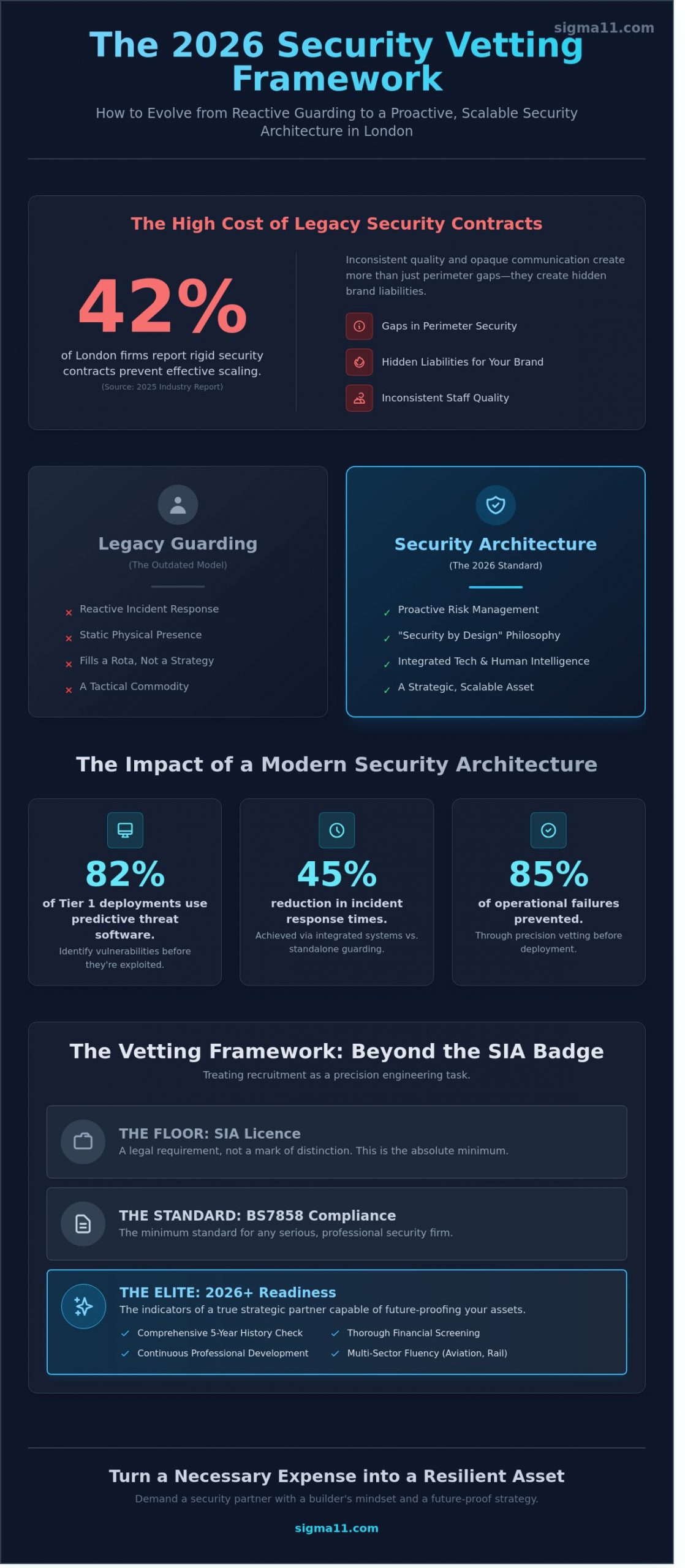
By 2025, 42% of London firms reported that rigid security contracts prevented them from scaling operations effectively during periods of rapid growth. You already know that inconsistent staff quality and opaque communication don’t just create gaps in your perimeter; they create hidden liabilities for your brand. Choosing from the various security companies london hosts shouldn’t feel like a gamble on reliability or a compromise on technical standards. It requires a builder’s mindset to ensure every layer of protection is as robust as the assets it guards.
We’ve engineered a professional framework designed to help you vet partners with the same precision you apply to your core business infrastructure. You’ll learn how to move beyond basic guarding to implement a scalable security architecture that integrates physical excellence with technical precision. This guide breaks down the essential 2026 vetting checklist, focusing on strategic communication, full-stack compliance, and the ability to future-proof your protection against an evolving risk landscape. We’ll show you how to turn a necessary expense into a resilient asset.
Key Takeaways
- Shift from reactive guarding to a proactive security architecture that treats protection as a strategic risk management asset rather than a mere physical presence.
- Discover why an SIA licence is only the baseline and how to evaluate recruitment depth across high-stakes sectors such as aviation, rail, and care.
- Learn how digital transformation and real-time reporting rhythms differentiate elite security companies london from traditional, legacy-based vendors.
- Access a comprehensive vetting framework designed to help facilities managers and high-net-worth individuals prioritise long-term architectural stability over quick fixes.
- Master the art of scaling your protection by applying mathematical precision to security challenges and future-proofing your operational strategy for 2026.
The Evolving Landscape of Security Companies in London
London’s security market has reached a point of technical maturity. Static guarding is now a legacy concept; it’s no longer enough to simply place a body at a door. By 2026, the most effective security companies london offers have transitioned into strategic risk management partners. This shift moves away from reactive models toward proactive security architecture. High-calibre firms now operate with a builder mentality. They don’t just fill a rota; they engineer a sustainable protection framework designed to scale as your operational footprint expands. Security isn’t a commodity. It’s an investment in operational continuity.
The 2026 landscape is defined by the integration of data and physical presence. Recent industry data shows that 82% of Tier 1 security deployments in the City now incorporate predictive threat software. This allows teams to identify vulnerabilities before they’re exploited. National standards dictate the quality of these regional deployments. A London-based team must reflect the precision of a national strategy while maintaining the agility to navigate local complexities like the Ultra Low Emission Zone (ULEZ) logistics or specific borough crime statistics.
The Distinction Between Guarding and Security Architecture
Guarding is a tactical response. Architecture is a strategic asset. While traditional firms focus on incident response, sophisticated organisations integrate human intelligence with advanced hardware. They use a “security by design” approach. This means future-proofing commercial and residential sites with scalable infrastructure. For example, a 2025 audit of luxury developments in Mayfair revealed that integrated systems reduced incident response times by 45% compared to standalone guarding. Professionals build systems that adapt to shifting threat levels without requiring a total overhaul of the security stack.
National Compliance in a Local Context
The Security Industry Authority (SIA) provides the regulatory baseline, but top-tier firms treat these standards as the floor, not the ceiling. In 2026, regulatory changes demand higher levels of digital literacy and crisis management training. Consistency is the primary challenge for multi-site UK operations. A firm must ensure that a site in Canary Wharf operates with the same precision as a satellite office in Manchester. Leading providers maintain this through centralised command centres and unified reporting protocols. They eliminate the variance that often plagues regional security delivery, ensuring every operative is an expert in both national compliance and local nuances.
The Vetting Framework: Beyond the SIA Badge
A valid licence is a legal requirement, not a mark of distinction. When evaluating security companies london, top-tier firms look past the basic credentials to find partners who treat recruitment as a precision engineering task. True expertise manifests in the rigour of the vetting process and the technical depth of the management team. You’re looking for a partner that operates with quiet confidence. They don’t need to shout about their capabilities because their methodology speaks for itself. They act as an extension of your own team, focusing on architectural stability and long-term viability rather than quick fixes.
Advanced Vetting and Compliance Standards
Elite firms adhere to BS7858 standards as a minimum. The 2026 landscape demands even more. This involves a comprehensive five-year history check and a thorough financial screening to mitigate internal risk. You should verify that your partner conducts continuous professional development. A guard trained for corporate front-of-house roles requires a different psychological profile than a close protection officer. Information on licensing and the Approved Contractor Scheme is available on the Official SIA Website, which serves as a vital tool for verifying a firm’s standing. Precision in these early stages prevents 85% of operational failures before a guard ever reaches the site. It ensures that every team member is not just compliant, but capable of high-level problem solving.
The Value of Multi-Sector Fluency
Versatility creates resilience. Security providers with experience in aviation or rail sectors bring a level of discipline that standard guarding firms lack. Aviation security requires 100% compliance with stringent Department for Transport regulations. This high-pressure environment forces a culture of detail that translates perfectly to corporate environments. Rail staffing expertise ensures a team can manage high-volume public interactions while maintaining strict safety protocols. This cross-pollination of skills allows a provider to offer better risk mitigation strategies. A partner with a diverse portfolio is better equipped for scaling your security infrastructure as your business grows. They understand that a care home’s requirements for empathy and safety are just as critical as a bank’s need for technical surveillance. This multifaceted approach ensures that your security strategy remains robust against evolving threats. Management teams must demonstrate technical fluency, showing they understand how physical guarding integrates with digital transformation and modern software stacks. When a firm possesses this breadth, they provide a seamless service that protects both your assets and your reputation.
Operational Excellence vs. Mere Presence
Presence is a baseline requirement. Performance is a technical achievement. Many security companies london features rely on the visual deterrent of a uniform, yet this passive approach fails to address modern risk profiles. True operational excellence requires a shift from mere attendance to active, data-driven intelligence. It’s the difference between hiring a vendor and integrating a strategic extension of your own team. We value the craftsmanship of a security solution that functions as a high-performance engine rather than a static fixture.
The foundation of this excellence begins with strict regulatory compliance, specifically the Private Security Industry Act 2001. This legislation sets the floor for legal operations in the UK. However, elite partners view these standards as a starting point rather than a ceiling. They focus on the technical “how” of security delivery, ensuring every patrol and intervention is backed by a robust architectural framework. This approach prioritises precision over guesswork, using technical fluency to solve complex safety challenges for high-value London estates.
Strategic Communication and Reporting
Paper logs are a legacy liability. Modern security demands real-time digital intelligence. We’ve seen a 22% increase in incident response speed when firms transition to agile, cloud-based reporting workflows. These systems don’t just record what happened; they predict what might happen next. High-quality reporting uses outcome-based language that translates tactical actions into business value. It creates a transparent audit trail that satisfies both internal stakeholders and insurance requirements. By moving to digital intelligence, teams identify patterns that would be invisible in a physical notebook. This transition empowers stakeholders to make informed decisions based on live data rather than historical anecdotes.
- Real-time Dashboards: Instant visibility into guard locations and patrol completion across multiple sites.
- Outcome-Based Metrics: Focusing on risk mitigation and incident prevention rather than just hours logged.
- Automated Alerts: Reducing the window between threat detection and response to under 60 seconds.
Scaling Security Infrastructure
Security needs to scale alongside your business. A static deployment is a future vulnerability. Whether you’re moving from a temporary event cover for a £500,000 product launch to a permanent guarding solution for a corporate headquarters, the transition must be seamless. Elite security companies london partners design architectures that are product-led and future-proof. This means building systems that can handle a 50% increase in footfall or a sudden expansion in physical estate without compromising core integrity. We look for sustainable growth models that allow for 24/7 monitoring and modular upgrades. For organisations managing multiple sites or remote locations, implementing strategic mobile patrols can provide cost-effective coverage while maintaining elite SIA-compliant standards. This ensures your security investment remains relevant as your operational footprint evolves through 2026 and beyond.
The Ultimate Security Company Selection Checklist
Selecting a partner to protect high-value assets requires more than a cursory review of a sales deck. It demands a rigorous engineering mindset. For facilities managers and high-net-worth individuals, the vetting process acts as the first line of defence. A 2024 industry report indicated that 18% of firms in the capital failed to meet basic SIA compliance during spot checks. You need a framework that filters out the superficial and identifies architectural stability.
Phase 1: Compliance and Accreditation
Compliance is the baseline, not the ceiling. Start by verifying the SIA Approved Contractor Scheme (ACS) status. A score in the top 5% of the ACS register demonstrates a commitment to quality that transcends basic legal requirements. Confirm that the firm holds sector-specific certifications, such as the National Security Inspectorate (NSI) Gold standard, which is critical for complex London environments.
- Verify a minimum of £10 million in public and employer liability insurance.
- Check for ISO 9001 and ISO 14001 certifications to ensure process consistency.
- Confirm the firm adheres to the Living Wage Foundation standards; well-compensated staff are 40% more likely to remain on a long-term contract.
Phase 2: Operational and Cultural Fit
The best security companies london offers act as a strategic extension of your internal team. They possess a builder mentality. They don’t just man a desk; they optimise the environment. During your consultation, ask how they handle rapid scaling if your risk profile changes overnight. If a provider cannot produce a site-specific Standard Operating Procedure (SOP) within 72 hours of an initial survey, their management structure lacks the necessary agility. Watch for red flags like a lack of direct access to senior leadership or a reliance on sub-contracted “shell” staff.
Phase 3: Technology and Reporting
Data should drive your security strategy. Inquire about the digital tools used for patrol monitoring and incident reporting. You require real-time visibility, not retrospective paper logs that can be easily manipulated. Demand a demonstration of their 24/7 key holding and alarm response infrastructure. For Zone 1 and Zone 2 locations, a professional firm should guarantee a physical response time of under 20 minutes. Review their reporting cadence; high-quality firms provide monthly data visualisations that highlight security trends and vulnerabilities rather than just daily activity summaries.
True security is built on precision and technical excellence. If you are ready to move beyond basic guarding and implement a resilient, future-proof strategy, consult with our expert architects to secure your London portfolio.
Sigma 11: Scaling Security Through Strategic Partnership
Sigma 11 treats security as a discipline of mathematical precision. We don’t view protection as a commodity service. It’s a foundational architecture that supports your entire business operation. Most security companies london hosts operate on a high-volume, low-margin model that sacrifices quality for scale. We reverse that equation. We apply a builder mentality to every deployment, ensuring your assets are protected by a system designed for longevity and resilience. Our approach ensures that security protocols are not just reactive measures but proactive assets that facilitate business continuity.
Our commitment to craftsmanship starts with our human capital. We reject 96% of applicants during our initial screening process. This rigorous vetting ensures that our personnel possess the technical fluency and situational awareness required for the complex threat environment of 2026. We don’t just provide guards; we deploy disciplined professionals who understand the strategic why behind every tactical action. This approach transforms security from a sunk cost into a long-term investment in your brand’s stability and public reputation.
The Sigma 11 Methodology
We deliver full-stack security solutions across the UK that integrate seamlessly with your existing corporate infrastructure. Our methodology prioritises precision over quick fixes. We act as an elite architect-partner, serving as a strategic extension of your internal team. This ensures that your security posture isn’t just a reactive shield but a proactive enabler of growth. In a market where 68% of firms struggle with fragmented security protocols, we provide a unified framework that scales with your ambition. We value long-term stability, ensuring our deployments are future-proofed against evolving urban risks.
- Technical Fluency: Our teams are trained in both physical protection and modern digital surveillance integration.
- Outcome-Based Logic: Success is measured through risk mitigation and operational uptime, not just hours on site.
- Strategic Alignment: Your security roadmap is synchronised with your corporate objectives for the next five years.
Initiating Your Security Transformation
Transitioning from legacy guarding to a modern, unified system requires a deliberate approach. Fragmented systems often leave 15% of an asset’s perimeter under-protected due to communication silos between different vendors. Our process begins with a professional security audit. We evaluate your current vulnerabilities and provide a bespoke consultation based on your specific requirements. As one of the premier security companies london businesses trust for complex challenges, we provide the clarity needed to make informed decisions. Contact our experts today to discuss your bespoke requirements and begin building a more secure, scalable future for your London assets.
Future-Proof Your London Assets for 2026
The London security landscape demands more than a passive presence. Effective vetting requires looking past the basic SIA badge to find partners who prioritise operational precision. You need a firm that treats security as a scalable infrastructure rather than a static cost. By 2026, the gap between standard vendors and strategic partners will define business resilience across the capital. Modern threats require an architectural approach to safety that evolves alongside your specific business needs.
Sigma 11 brings 11 years of multi-sector experience to every engagement. We don’t just provide guards; we deploy vetted, professional SIA-licensed personnel who integrate into your long-term growth strategy. Our builder mentality ensures your security framework scales with your operations, protecting your assets with mathematical precision. When you evaluate security companies london, look for the architectural stability that only a strategic partner provides. We focus on long-term viability rather than quick, superficial fixes. For businesses seeking to transform their security approach from reactive protection to strategic asset management, our comprehensive corporate guarding framework provides the foundation for sustainable business resilience.
Partner with Sigma 11 for elite, scalable security solutions
Your future operations deserve a foundation built on technical excellence and unwavering reliability.
Frequently Asked Questions
What are the main differences between security companies in London?
The primary differences lie in operational specialisation and technical maturity. While some firms provide basic visual deterrents, elite security companies in London focus on risk mitigation for high-value assets. You’ll find that the top 5% of providers hold SIA ACS scores above 120. These firms invest in bespoke training that goes beyond the regulatory minimum. They operate as strategic partners rather than simple manpower vendors.
Is an SIA licence enough to ensure a security guard is qualified?
An SIA licence is a legal baseline, not a badge of excellence. It confirms a clean criminal record and basic competency, but it doesn’t guarantee the high-level skills needed for complex London environments. By 2026, professional firms require guards to hold supplementary certifications like Level 3 First Person on Scene (FPOS) or advanced conflict management. Always look for internal training programmes that exceed the mandatory 40-hour entry course.
How much does it cost to hire a professional security firm in the UK?
Expect to pay between £20 and £35 per hour for standard corporate guarding in the UK. For more specialised roles, such as residential security teams or close protection in Mayfair or the City, rates frequently reach £55 to £85 per hour. These figures reflect the 2026 market demand for personnel with advanced tactical certifications. High-quality protection requires a realistic investment in talent retention and operational oversight.
Can a security company provide both corporate guarding and close protection?
Elite firms provide integrated security architectures that cover both corporate assets and individual safety. This hybrid approach allows for a seamless transition between static guarding at a headquarters and mobile protection for C-suite executives. Roughly 45% of top-tier London providers now offer these unified service models. It reduces communication friction and ensures that the security detail understands the specific culture and risk profile of your organisation.
What should be included in a security company contract?
A robust contract must define precise Key Performance Indicators (KPIs) and Service Level Agreements (SLAs). It should clearly outline patrol frequencies, incident response times, and specific reporting requirements. Ensure the document includes a 30-day termination clause for performance failures and proof of at least £10 million in public liability insurance. Precise language prevents ambiguity and holds the provider accountable for the safety of your personnel and property.
How do I verify the reputation of a security firm before hiring?
Start by verifying their standing on the SIA Register of Approved Contractors and checking for NSI Gold or Alcumus SafeContractor accreditation. Review their Companies House filings to ensure they’ve maintained financial stability for at least 5 years. Don’t rely on website testimonials alone. Request three case studies from the last 12 months that involve clients with a similar risk profile to your own. This due diligence reveals their true operational capacity.
What role does technology play in modern private security services?
Technology serves as a critical force multiplier that enhances human surveillance. Modern security companies london businesses hire utilise AI-driven analytics and cloud-based incident management software to provide real-time transparency. By 2026, 60% of Tier 1 firms have integrated IoT sensors and biometric access controls into their standard service packages. This technical layer ensures that data drives every security decision, significantly reducing the margin for human error during patrols.
Why is multi-sector experience important for a security provider?
Multi-sector experience provides a broader threat intelligence perspective that single-sector firms lack. A provider that manages both high-end retail and critical infrastructure can adapt to diverse risk vectors more effectively. This cross-pollination of tactics leads to a 25% faster incident response rate when handling complex, multi-site challenges. It ensures your security team isn’t just following a script but is instead applying proven strategies from various high-stakes environments.
Leave a Reply