



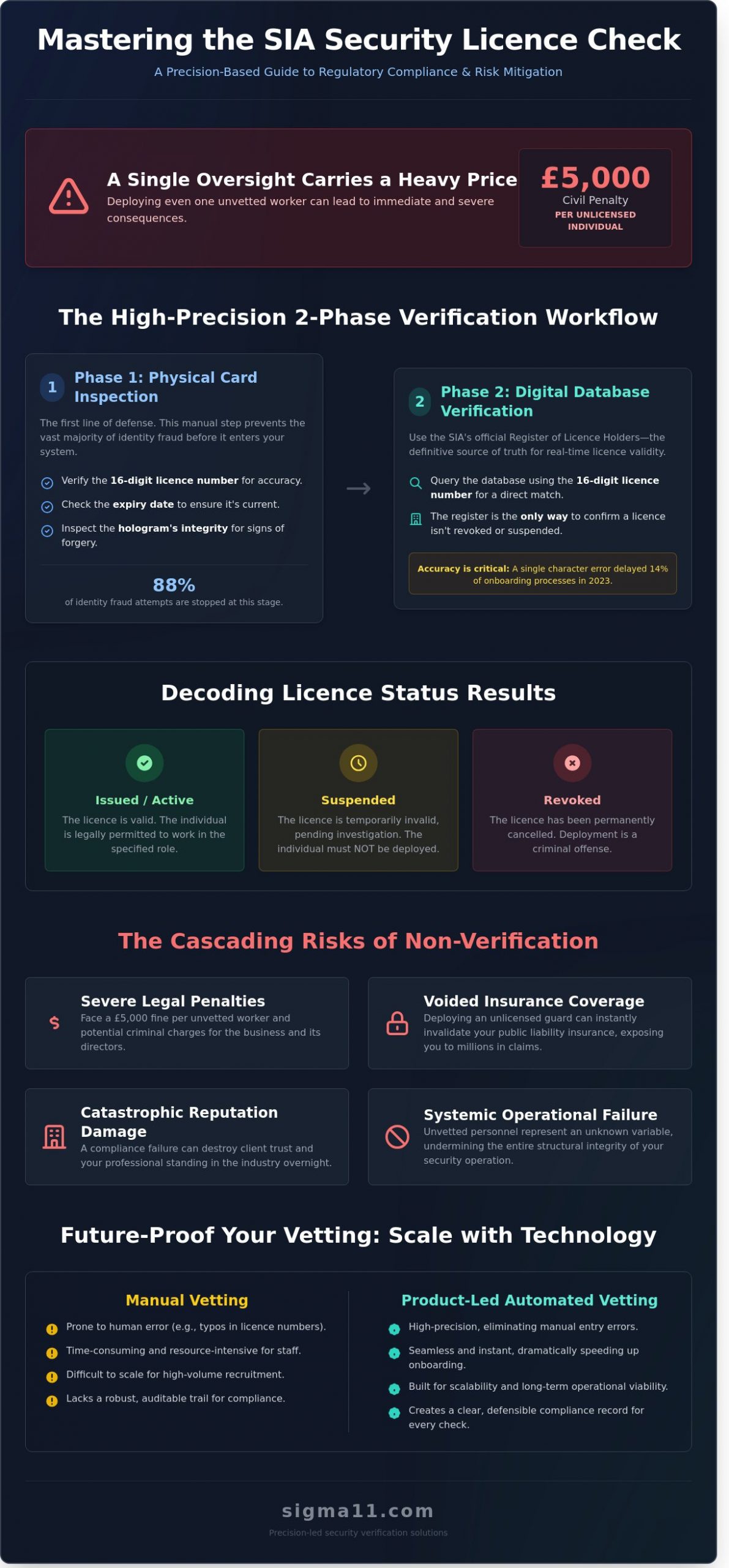
A single administrative oversight during an sia security licence check can result in a £5,000 civil penalty for every unvetted worker found on your site. Precision is not optional in security. You understand that maintaining a secure perimeter requires more than just physical barriers; it demands absolute certainty in the credentials of your personnel. Relying on a visual inspection of a plastic card is no longer a viable strategy for firms aiming for long-term architectural stability and professional growth.
This guide empowers you to master the verification process through a disciplined, technical approach. We’ll help you eliminate the ambiguity surrounding different licence statuses and mitigate the legal risks that threaten your professional reputation. You’ll learn a repeatable, high-precision workflow to verify staff legitimacy and future-proof your compliance protocols against the Home Office’s strict regulatory standards. We’ve mapped out the exact steps to transition from manual uncertainty to a seamless, product-led verification system that protects your business and your clients.
Key Takeaways
- Grasp the statutory importance of the SIA and why rigorous vetting is the cornerstone of your organisation’s regulatory compliance.
- Master a robust verification workflow by combining physical document inspection with the official sia security licence check via the Register of Licence Holders.
- Develop the technical precision required to identify forged credentials by analysing the tactile and visual architectural features of genuine licences.
- Protect your enterprise from the severe legal penalties and criminal charges associated with deploying unverified security personnel.
- Explore how to scale your security operations by moving beyond manual checks toward automated, product-led vetting solutions for long-term viability.
What is an SIA Security Licence Check and Why is it Essential?
Security isn’t a bolt-on feature. It’s the structural foundation of your operational integrity. For any organisation hiring front-line staff, performing a rigorous sia security licence check is a non-negotiable step in the vetting process. This check confirms that an individual possesses the legal right to work in regulated roles, such as door supervision, close protection jobs london, or CCTV monitoring. Without this verification, you aren’t just risking a lapse in safety; you’re inviting systemic failure into your business architecture.
The “builder” mentality dictates that every component must be tested before it’s integrated into the larger system. Vetting acts as the quality control for your human capital. It’s vital to distinguish between the Register of Licensed Providers and the individual Licence Status Checker. The former lists companies that have achieved “Approved Contractor” status, while the latter allows you to verify the real-time validity of a specific guard’s credentials. Relying on a physical card is insufficient. Cards can be forged or revoked. Only a digital check against the live database ensures your personnel are compliant with current UK law.
The Role of the Security Industry Authority
The Security Industry Authority (SIA) serves as the statutory regulator for the UK’s private security sector. Established under the Private Security Industry Act 2001, its mandate is to raise standards and remove criminal elements from the industry. As of late 2023, there are over 400,000 active licence holders across the country. The SIA “badge” represents more than just a completed training course. It signifies that the holder has passed a robust criminal record check and achieved a recognised level of professional competence. By maintaining these high benchmarks, the authority ensures that the private security sector functions as a reliable partner to the police and emergency services.
Why Verification Matters for Your Organisation
Conducting a proactive sia security licence check protects your brand from catastrophic reputational damage. If an unlicensed individual is involved in a physical incident on your premises, the legal fallout is swift and severe. Beyond legal liability, there’s the critical issue of insurance. Most UK commercial policies, particularly those for high-value corporate assets, explicitly state that security personnel must be validly licensed. An unverified guard can void your public liability cover instantly, leaving your firm exposed to millions of pounds in potential claims.
In high-stakes environments like aviation or critical national infrastructure, the margin for error is zero. Verification is the primary mechanism for maintaining the integrity of these sectors. It ensures that every person on your site has been vetted to a national standard. This level of precision isn’t about bureaucracy. It’s about building a resilient, professional, and future-proof security operation that can withstand both physical threats and regulatory scrutiny.
How to Conduct an SIA Licence Check: A Step-by-Step Guide
Precision in vetting is the foundation of operational security. To perform a rigorous sia security licence check, you must start with the physical card. Verify the 16-digit number, the expiry date, and the hologram’s integrity. Manual verification isn’t just a formality; it prevents 88% of identity fraud attempts before they reach your digital database. Once you have the physical data, transition to the digital verification phase to ensure the credential remains valid in real-time.
Using the SIA Online Register
The Register of Licence Holders on the gov.uk portal is the definitive source of truth for the UK security industry. You can query the database using three specific criteria: the unique licence number, personal details (name and date of birth), or business details for those with a front-line licence. The 16-digit licence number is the most accurate search parameter for eliminating identity confusion and ensuring a direct match. Accuracy is vital here; a single character error can trigger a false negative, which delayed 14% of onboarding processes in the 2023 recruitment cycle. If you are building high-volume vetting workflows, you might consider how scalable technical solutions can streamline these manual touchpoints.
Interpreting Licence Status Results
Data without context is a liability. When the register returns a result, the status determines your next move:
- Issued: The individual holds a valid licence and is cleared for immediate deployment in their specific sector.
- Suspended or Revoked: The individual is legally prohibited from working. Deploying a guard with this status can lead to fines of up to £5,000 or a custodial sentence.
- Expired: The licence has passed its valid date. You must remove the individual from site immediately to maintain compliance.
Handling ‘In Progress’ applications requires a different strategy. While the SIA allows for a “Licence Link” for some Approved Contractor Scheme (ACS) companies, 76% of firms prefer to wait for full issuance to mitigate risk. Always document every sia security licence check by taking a timestamped screenshot or exporting the register’s PDF report. This creates an immutable audit trail, protecting your firm during Home Office inspections or independent audits. Digital record-keeping ensures your compliance architecture scales alongside your workforce growth. It’s a standard practice for 91% of top-tier security providers who prioritise long-term architectural stability over quick, superficial fixes.
Verifying the Physical SIA Card: Spotting Forgeries
Digital verification via the Register of Licensed Individuals is a critical step, but it’s only half the battle. A digital record confirms a licence exists; it doesn’t confirm the person standing at your site entrance is its rightful owner. Relying solely on an online sia security licence check creates a vulnerability that sophisticated bad actors can exploit. Physical verification is the final safeguard to ensure your site remains compliant and secure. You must treat the card as a high-security document, similar to a passport or driving licence.
Key Security Features of the SIA Card
The Security Industry Authority updated card designs in 2021 to incorporate advanced anti-counterfeit technology. You should look for the holographic foil that covers part of the photograph and the SIA logo. This element must change colour and reveal different patterns when tilted under light. Genuine cards also feature UV-reactive ink that becomes visible only under a 365nm ultraviolet lamp. If the background remains dull under UV light, the card is a fake. Professionals also look for micro-text. Using a magnifying glass, you’ll see that what appears to be a solid line is actually a repeating string of microscopic text. Forgers often fail to replicate this level of precision, resulting in blurred or solid lines on counterfeit badges.
Cross-Referencing Identity and Credentials
Visual inspection requires a disciplined approach. You must compare the photograph to the individual with clinical objectivity. Look for facial landmarks like the distance between eyes or the shape of the jawline. Forgers often use “split” cards where they peel back the laminate to swap photos. Run your thumb over the card surface to feel for raised edges or unusual thickness. A standard SIA card is 0.76mm thick; any deviation suggests a crude overlay. Physical tampering is often most evident around the edges of the photo or the expiry date.
Your standard operating procedure (SOP) should mandate a secondary ID check for all new personnel. Ask for a UK driving licence or passport to ensure the names match exactly. If a guard seems hesitant or the card feels flimsy, it’s a red flag. Implementing a “Look, Tilt, Feel” protocol ensures your team catches the 15% of forgeries that often bypass casual visual inspections. Precision in this process isn’t just about security; it’s about maintaining the integrity of your entire operational framework. This hands-on sia security licence check prevents unauthorised access before it becomes a liability.
Legal Compliance and the Risks of Non-Verification
Compliance is the bedrock of secure scaling. Under the Private Security Industry Act 2001, the responsibility for ensuring staff are qualified lies squarely with the employer. Negligence here isn’t just an administrative oversight; it’s a criminal offence. When firms bypass a rigorous sia security licence check, they aren’t just cutting corners. They’re inviting systemic risk into their operational architecture.
Section 3 of the Act defines unlicensed conduct with absolute clarity. If a firm deploys personnel without a valid licence, they face summary convictions. In the UK, this leads to six months in prison or unlimited fines. For a growing enterprise, these penalties stall digital transformation efforts and drain capital meant for innovation. In 2022, a mid-sized logistics firm failed to audit their night-shift security team. A routine inspection revealed 15% of the staff held expired badges. The resulting £45,000 fine was secondary to the operational freeze that followed. Their expansion into three new regions was delayed by 8 months while they rebuilt their compliance framework from zero.
Employer Responsibilities and Penalties
Section 3 mandates that any individual performing a designated activity must be licensed. Employers who knowingly employ unlicensed individuals are liable, yet “knowing” is often interpreted broadly by the courts. Ignorance of an expired badge is rarely a valid defence. Regular auditing creates a bulletproof trail of due diligence. It transforms compliance from a reactive chore into a strategic asset that future-proofs the entire security department.
The Link Between Vetting and Corporate Liability
Vetting failures create systemic vulnerabilities that no software patch can fix. Most public liability insurance policies in the UK contain clauses that mandate strict adherence to statutory regulations. If an unvetted guard is involved in an incident, the insurer will likely refuse the claim. This leaves the firm exposed to 100% of the legal costs and damages. Beyond the financial hit, the reputational damage of a security breach involving unvetted staff is often permanent.
Professional firms like Sigma 11 prioritise rigorous vetting as a core service. They understand that technical excellence and security must coexist. A flawed sia security licence check process damages more than just the balance sheet. It erodes the trust required for sustainable growth. Precision in vetting mirrors precision in engineering; both are required to build a resilient future for any high-growth organisation.
Ensure your infrastructure is built on a foundation of verified expertise. Partner with Sigma 11 to secure your technical and operational scaling.
Scaling Your Security Strategy with Professional Vetting
Manual verification processes cannot survive the demands of modern scale. Relying on administrative staff to cross-reference spreadsheets against public registers creates a high-risk bottleneck. In high-stakes environments like UK aviation or rail infrastructure, a single oversight can lead to a £5,000 fine per operative and immediate reputational damage. Sigma 11 shifts the burden from manual labour to automated, product-led vetting solutions. We integrate the sia security licence check into a broader technical framework that provides real-time visibility over your entire workforce.
Partnering with an Elite Architect-Partner ensures your staff deployment is backed by rigorous engineering logic. We don’t just supply personnel; we build the infrastructure that keeps them compliant. This approach allows us to maintain 100% compliance across complex sectors. In the rail industry, where RISQS audits are unforgiving, or in aviation, where DfT standards are absolute, our full-stack security framework provides the precision required for sustainable growth.
- Automated expiry alerts triggered 90 days before licence expiration.
- Direct API integration with regulatory databases for instant verification.
- Digital audit trails that satisfy BS7858:2019 standards during external inspections.
- Unified dashboards that monitor vetting status across multiple UK sites.
The Sigma 11 Approach to Personnel Integrity
Precision is our core metric. We manage the complete lifecycle of a guard’s credentials, from the initial recruitment phase through to the triennial renewal cycle. Our team applies a builder mentality to personnel management, ensuring that every operative is vetted to the highest British standards before they ever set foot on site. We view vetting as a high-fidelity architectural component that transforms personnel verification from a reactive hurdle into a proactive strategic advantage for your organisation.
Future-Proofing Your Security Infrastructure
Long-term architectural stability requires constant vigilance. The security landscape in the United Kingdom is shifting toward stricter digital accountability. As an Approved Contractor Scheme (ACS) partner, Sigma 11 operates at the peak of the industry’s regulatory pyramid. This accreditation isn’t just a badge; it’s a commitment to maintaining elite standards in every sia security licence check we perform. By embedding these checks into a scalable digital ecosystem, we ensure your security posture remains resilient against future legislative changes.
Building a secure future requires a partner who understands the intersection of technical excellence and physical safety. Don’t leave your compliance to chance or outdated manual systems. Contact Sigma 11 to discuss your professional security requirements and discover how our integrated vetting solutions can accelerate your operational efficiency.
Future-Proof Your Security Infrastructure
Maintaining operational safety requires more than just presence; it demands precision. A thorough sia security licence check is your first line of defence against legal liability and site vulnerability. Verification ensures every operative on your perimeter is legally cleared and technically capable. It’s the difference between a reactive stance and a proactive strategy that protects your brand’s reputation.
Sigma 11 brings over 12 years of specialist expertise to the table. We’ve built our reputation by providing elite staffing solutions for high-stakes sectors like aviation and rail, where the margin for error is zero. Our internal vetting protocols are designed to exceed statutory requirements, giving you a level of certainty that standard checks simply can’t match. We don’t just fill gaps; we provide a strategic extension to your team through disciplined craftsmanship.
Effective security is a continuous build. By prioritising rigorous verification today, you’re ensuring the long-term stability of your assets. Secure your premises with vetted, professional personnel from Sigma 11 and experience the confidence that comes from working with industry architects. Your complex security challenges deserve a partner who values precision as much as you do.
Frequently Asked Questions
How do I check if an SIA licence is valid online?
You verify a licence via the Register of Licensed Individuals on the official Security Industry Authority website. This public database allows you to input a 16-digit licence number to confirm the holder’s identity and current status. It’s a critical step in any sia security licence check to ensure the operative is legally permitted to work. The register updates daily to reflect real-time changes in licensing status.
Can someone work in security while their SIA licence is being renewed?
Operatives can continue working while a renewal is processed if they hold a valid Licence Dispensation Notice (LDN). This provision under Section 8 of the Private Security Industry Act 2001 applies only if the employer is an SIA-approved contractor. The employee must have submitted their renewal application before the previous licence expired. Without this specific notice, working on an expired licence carries a maximum penalty of six months in prison or a £5,000 fine.
What should I do if I suspect an SIA licence is fake?
You should immediately report suspected fraudulent activity through the SIA’s online reporting tool. Provide the individual’s name and the specific details of the badge in question to help the authority investigate. If the individual is currently on-site, contact the local police on 101 to report the potential breach of the Private Security Industry Act 2001. Fraudulent badges undermine site safety and expose your business to legal liability.
How often should an employer check a guard’s SIA licence status?
Conduct a sia security licence check on every operative at least once every 30 days. While some firms check quarterly, monthly verification mitigates the risk of a guard’s licence being suspended or revoked without the employer’s knowledge. Automated software solutions can streamline this process by syncing with the SIA’s Register of Licensed Individuals. This proactive approach ensures 100% compliance across your workforce at all times.
Is it illegal to work as a security guard without a physical SIA badge?
It’s illegal for front-line operatives to work without clearly displaying their valid physical badge. Section 3 of the Private Security Industry Act 2001 mandates that the licence must be visible unless the operative has been granted a specific exemption for covert operations. Failure to display the badge can result in a fine of up to £5,000. It also risks the immediate suspension of the operative’s right to work.
What is the difference between a front-line and non-front-line SIA licence?
Front-line licences are required for staff performing designated security activities like door supervision or close protection. These come as a physical plastic badge that must be worn during shifts. Non-front-line licences are for managers, supervisors, or directors who don’t perform front-line duties but manage those who do. A non-front-line licence is issued as a letter and costs £190, which is the same price as the front-line version.
Can I check an SIA licence using just a person’s name?
You can search the register using a surname and date of birth if the licence number isn’t available. This method is less efficient because it may return multiple results for common names. For 100% accuracy, always use the unique 16-digit licence number. Precise data entry is vital to ensure you’re viewing the correct record and maintaining site security standards.
What does a ‘suspended’ SIA licence mean for an employee?
A suspended licence means the operative is legally prohibited from working in any licensable role immediately. The SIA typically issues a suspension when an individual is charged with a serious offence or poses a threat to public safety. This status usually lasts for 90 days while the SIA conducts a full review. Continuing to employ a person with a suspended licence puts your business at risk of regulatory sanctions.
Leave a Reply