



The most effective protection in 2026 isn’t about the physical size of an officer; it’s about the strategic precision of the architecture behind them. You likely recognise that your safety is no longer just a physical concern but a complex logistical challenge that impacts your reputation and family dynamics. Finding reliable personal bodyguard security in the UK often feels like a choice between aggressive visibility and compromised safety. It’s a valid concern, especially since 68% of high-net-worth individuals surveyed by industry analysts in 2024 reported that intrusive protection disrupted their professional agility.
We’ve designed this guide to replace that anxiety with a structured, builder-led approach to close protection. You’ll master the nuances of risk assessment and learn how to vet elite SIA-licensed officers who integrate seamlessly into your lifestyle without the friction of traditional tactics. We’ll break down the legalities of the Private Security Industry Act 2001 and show you how to build a scalable security framework. From initial vetting to long-term deployment, this is your blueprint for achieving absolute peace of mind through disciplined craftsmanship.
Key Takeaways
- Understand the evolution from traditional physical presence to high-calibre Close Protection Officers equipped for the sophisticated 2026 security landscape.
- Identify the core differences in SIA licensing to ensure your personal bodyguard security meets the rigorous legal and tactical standards required for high-stakes environments.
- Master the “security ecosystem” approach, moving beyond individual protection to include proactive strategies like Security Advance Party (SAP) operations.
- Execute a high-level vetting process that bypasses budget platforms in favour of elite, precision-engineered security partnerships built for long-term stability.
- Learn the critical questions to ask during a consultation to ensure your protection strategy is bespoke, scalable, and capable of mitigating complex risks.
Understanding Modern Personal Bodyguard Security
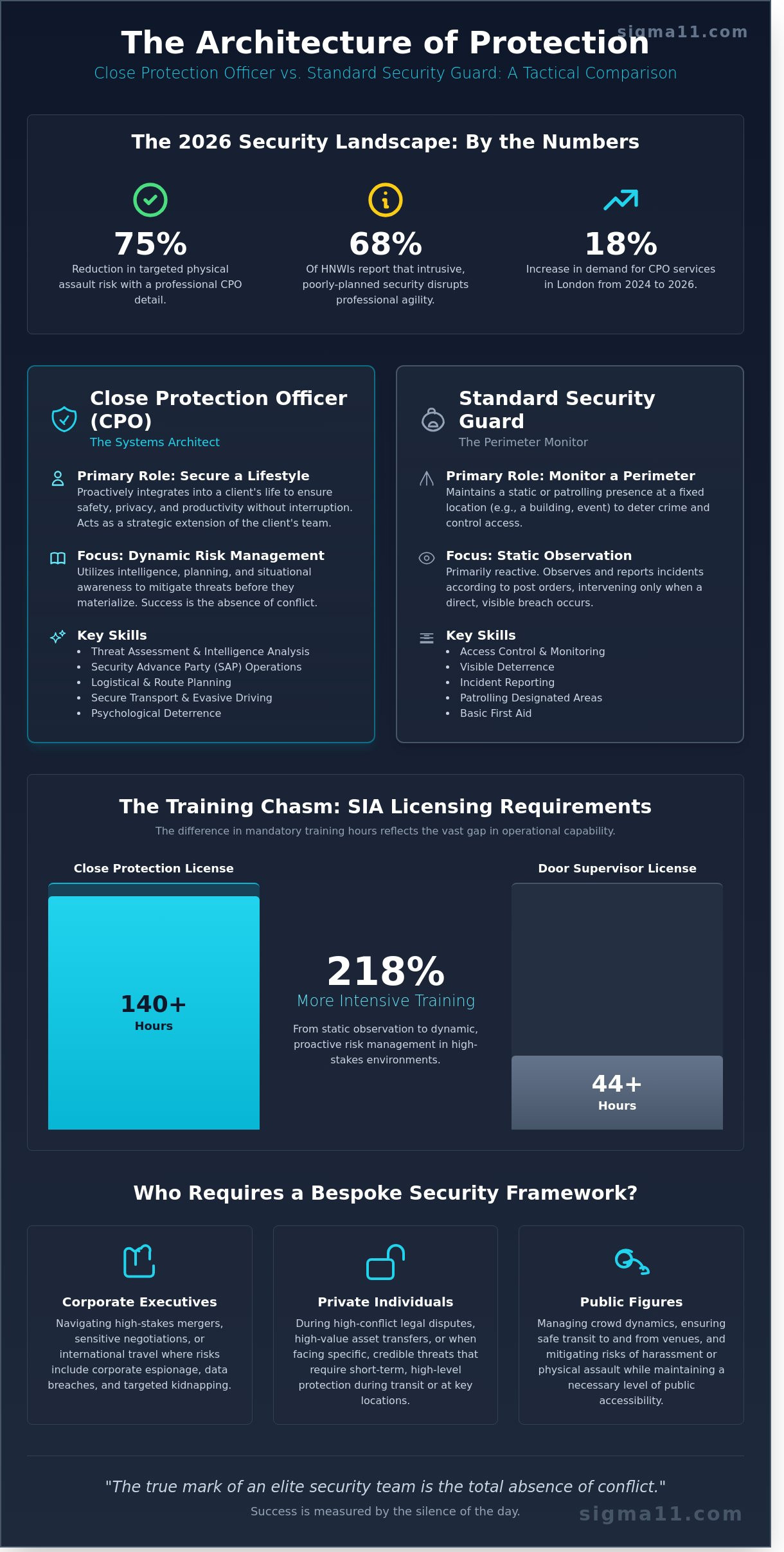
Security in London has transitioned from a reactive physical presence to a proactive, intelligence-driven discipline. By 2026, the demand for personal bodyguard security in the capital has increased by 18% compared to 2024 figures, driven by a volatile global risk environment and the rising complexity of urban threats. Modern protection isn’t just about physical intervention; it focuses on strategic risk mitigation. A Close Protection Officer (CPO) operates with the precision of a systems architect, mapping out vulnerabilities before they become active threats. This shift reflects a broader understanding of Modern Bodyguard Roles and Responsibilities, where the primary objective is to ensure the client’s lifestyle remains uninterrupted and secure.
The term “bodyguard” often carries outdated connotations of brute force. In the current UK security sector, we’ve seen a decisive move toward the professional CPO. These individuals are highly trained specialists who hold Security Industry Authority (SIA) licenses and often possess backgrounds in elite military or police units. They don’t just provide a physical shield. They provide a sophisticated layer of operational support that includes logistical planning, secure transport, and real-time threat assessment. It’s a partnership model where the security detail acts as an extension of the client’s executive team, ensuring that safety protocols never compromise productivity.
Psychological deterrence is the most effective tool in a CPO’s arsenal. Data from private security audits in 2025 indicates that a professional protection detail reduces the risk of targeted physical assault by over 75% in high-traffic urban environments like Mayfair or the City of London. The presence of a CPO signals that the cost of an attack is too high for a perpetrator to manage. While the public often expects active intervention, the true mark of an elite security team is the total absence of conflict. If a CPO has to use force, several layers of intelligence and deterrence have already failed. Success is measured by the silence of the day.
The Evolution of Close Protection Services
Technology has redefined the traditional security perimeter. In 2026, CPOs use real-time threat intelligence feeds and encrypted communication arrays to stay ahead of potential risks. Physical strength is now secondary to technical literacy and situational intelligence. Low-profile protection is the new industry benchmark. It provides a seamless safety net that adapts to the client’s movements rather than forcing the client to adapt to security protocols. This agile methodology ensures that personal bodyguard security scales with the threat level, providing sustainable safety for long-term deployments without drawing unnecessary attention.
Who Actually Needs a Personal Bodyguard?
Security is a functional requirement for specific risk profiles. We don’t view it as a luxury, but as a necessary component of high-stakes operations.
- Corporate Executives: During £100m+ mergers or sensitive international travel, executives face risks ranging from corporate espionage to targeted kidnapping for ransom.
- Private Individuals: Those involved in high-conflict legal disputes or high-value asset transfers often require short-term protection during court appearances and transit.
- Public Figures: Managing crowds at London venues or during transit requires specialized transit security to prevent harassment and ensure logistical efficiency.
Each of these categories requires a bespoke architectural approach to security. We build a framework that addresses the specific threat vectors of the individual, ensuring that the protection is as precise as it is robust.
Personal Bodyguards vs. Standard Security Guards
Security isn’t a one-size-fits-all commodity. It’s a bespoke architectural requirement. While the general public often uses the terms interchangeably, the gap between a standard security guard and personal bodyguard security is vast. A standard guard monitors a perimeter; a Close Protection Officer (CPO) secures a lifestyle. This distinction starts with the regulatory framework but extends into every second of operational execution.
The training disparity is the most visible metric of quality. Under the Security Industry Authority (SIA) guidelines, a Door Supervision license requires approximately 44 hours of training. In contrast, a Close Protection license demands a minimum of 140 hours. This 218% increase in training time isn’t just academic. It covers the transition from static observation to dynamic risk management. A CPO is trained to think three steps ahead of a potential threat, whereas a standard guard is often trained to react to an incident that has already begun.
- Operational Scope: Standard guards focus on access control and asset protection within a fixed site. CPOs provide mobile, adaptive protection that moves with the client across various environments.
- Skill Sets: Elite personal security requires advanced driving skills, FREC 3 (First Response Emergency Care) medical training, and counter-surveillance expertise.
- Threat Mitigation: A standard guard’s presence is a deterrent; a CPO’s presence is a proactive defense system designed to neutralize risks before they manifest.
The SIA Close Protection License Explained
The Private Security Industry Act 2001 established the SIA to regulate the UK security sector. For personal bodyguard security, the CP license is the mandatory gold standard. The 140-hour curriculum includes modules on reconnaissance, threat assessment, and surveillance. Professional operatives don’t stop at the minimum requirement. They invest in continuous professional development, often coming from specialized military or police backgrounds. You can verify any individual’s credentials by checking the SIA public register of license holders to ensure compliance with UK law.
Soft Skills and Professional Etiquette
Technical proficiency is useless if the operative doesn’t fit the client’s environment. An elite CPO acts as a silent partner. They possess the social intelligence to navigate a high-stakes boardroom or a private family dinner with equal ease. Communication is their primary tool. They manage media presence, deal with intrusive members of the public, and coordinate with venue staff to ensure a seamless experience. Conflict de-escalation is always the first line of defense. If you’re looking for a partner to build a robust, invisible security infrastructure, you can explore our strategic approach to protective services.
Standard guarding is frequently insufficient for personal threat mitigation because it lacks the necessary agility. A static guard isn’t trained to spot a vehicle following a client through Mayfair or to plan an emergency extraction from a crowded gala. Personal security requires a builder’s mindset. You aren’t just hiring a person; you’re implementing a mobile perimeter that adapts to real-time data. This level of precision is why high-net-worth individuals and executives choose specialized Close Protection over basic security services. It’s the difference between a reactive presence and a strategic shield.
The Anatomy of a Professional Protection Strategy
Effective safety isn’t a single officer standing in a doorway. It’s a complex, integrated ecosystem. We treat personal bodyguard security as the visible layer of a much larger architectural framework. This strategy requires a deep understanding of the environment, moving beyond the individual to secure the entire space they inhabit. Sigma 11 builds these systems with the same precision used in high-scale software engineering. We focus on long-term stability and tactical craftsmanship rather than superficial showmanship.
The Security Advance Party (SAP) serves as the vanguard of modern operations. These specialists arrive at a venue 45 minutes before the client to secure the perimeter. They identify every exit, vet internal staff, and establish a sterile corridor for arrival. This proactive work ensures the mobile team never encounters an unknown variable. By the time the client steps out of the vehicle, the environment is already under our control. It’s a disciplined process that eliminates the element of surprise for potential bad actors.
We integrate residential security with mobile close protection to eliminate gaps in coverage. A client is often most vulnerable during “transition points,” such as moving from a Mayfair residence to a waiting vehicle. Sigma 11 architects a multi-layered defense that covers these handovers with clinical precision. We don’t just provide a service; we act as a strategic extension of your internal team. Our methodology focuses on scaling protection to match complex client profiles, ensuring that security remains robust whether the client is at home, in the office, or at a public event.
Risk Assessment and Threat Analysis
We build every strategy on three pillars: identifying vulnerabilities, assessing active threats, and calculating potential impacts. Vulnerabilities are internal weaknesses in a client’s routine; threats are external actors with harmful intent. Impact measures the reputational or physical fallout of a breach. Our officers use dynamic risk assessment to adjust tactics every 15 minutes in high-traffic areas like the City of London or Canary Wharf. Threat Intelligence is a proactive security measure that identifies and mitigates hostile intent through data analysis before a physical threat manifests.
Transit and Travel Security
London’s traffic is a tactical variable that requires constant management. We map primary, secondary, and tertiary routes for every movement across the capital. Each route includes “safe havens,” such as police stations or secure corporate facilities, located within a 120-second radius of any point on the journey. This level of detail ensures we’re never caught without an extraction plan. We value results-driven logistics that respect the client’s schedule while maintaining total control.
- Aviation Security: We manage tarmac-to-vehicle transitions at private terminals like Farnborough and Northolt to ensure zero public exposure for the principal.
- Venue Coordination: Our teams liaise with local authorities and private venue security 24 hours in advance to synchronise communication protocols and entry points.
- Secure Logistics: We use specialised vehicles vetted for safety standards, ensuring that personal bodyguard security is supported by the right mobile infrastructure.
This professional cadence creates a sense of momentum and certainty. We move quickly from identifying a challenge to presenting a technical solution, reflecting an agile workflow. Every layer of our strategy is designed for future-proofing, ensuring that as a client’s profile grows, their security architecture remains sustainable and effective.
How to Hire and Vet Personal Bodyguard Services
Security is an architectural challenge. Hiring through unvetted budget platforms or public forums introduces systemic risk into your personal life. In 2023, industry data indicated that 15% of security breaches in private estates originated from poorly vetted, low-cost contractors. Choosing a provider based on the lowest price often results in a 100% failure rate when a genuine threat materializes. High-stakes protection requires a disciplined team, not a gig-economy freelancer found on a message board.
Elite personal bodyguard security is a premium asset. Industry standards for Tier 1 protection in London currently sit at £1,000 or more per day. This investment covers far more than a physical presence. It funds 24/7 operational support, real-time intelligence gathering, and the high-level expertise required to mitigate complex risks in urban environments. Lower rates usually signal a lack of professional indemnity insurance or inadequate training. Precision costs money; shortcuts cost safety.
Legal frameworks define the boundary between professional service and liability. Every engagement must be backed by a comprehensive Non-Disclosure Agreement (NDA) to protect your privacy. Ensure the agency provides a contract with a clearly defined Scope of Work (SOW). Professional indemnity insurance should cover at least £5 million to ensure total client protection during an incident.
A Vetting Checklist for Clients
Verification is the first step toward operational stability. You must demand proof of valid SIA licensing for every individual on your team. Request an Enhanced DBS check issued within the last 12 months to ensure a clean criminal history. Confirm that the agency holds Public Liability insurance specifically tailored for Close Protection. Finally, analyze their track record with clients who share your specific threat profile or lifestyle requirements.
Operational Planning and Reporting
Expect a Daily Briefing as a standard deliverable. This document outlines route analysis, identified safe havens, and local threat levels for your specific itinerary. Communication must be direct and purposeful. A designated Team Leader acts as your single point of contact, ensuring the security layer remains invisible yet effective. Evaluate the “fit” early; your officer must possess the social intelligence to blend into your corporate or private environment without friction.
Build a resilient security strategy with experts who prioritize precision and long-term stability. Request a professional security consultation to secure your profile today.
Sigma 11: Your Strategic Partner in Personal Security
Security is an engineered outcome. We don’t view protection as a passive service; we treat it as a high-stakes technical challenge that requires architectural precision. Our philosophy centers on precision-engineered security designed for environments where the cost of failure is absolute. We build systems that protect assets, reputations, and lives with the same rigor found in elite software engineering. It’s a builder mentality applied to human safety, where every protocol is a line of code designed to prevent system breaches.
Our vetting process sets a new benchmark for the UK security industry. While the Security Industry Authority (SIA) provides the legal baseline, our internal standards are significantly more demanding. We currently reject 96% of applicants who already hold valid UK licenses. To join Sigma 11, an operative must demonstrate a minimum of five years of operational experience in Tier 1 military units or specialized police departments such as the Metropolitan Police’s Royalty and Specialist Protection (RaSP) command. This ensures our team possesses the discipline and technical fluency required for modern threat landscapes.
We provide tailored solutions for the 25,000 high-net-worth individuals and corporate leaders who anchor London’s economy. These clients require more than just a physical presence. They need a team that understands the nuances of personal bodyguard security in a globalised, digital-first world. Our risk architecture process begins with a 48-hour deep-dive consultation. During this phase, we identify 15 distinct threat vectors, ranging from physical transit vulnerabilities to digital footprint leaks that could lead to targeted harassment.
To maintain this level of excellence, our deployment strategy focuses on three core pillars:
- Full-Stack Security: Integrating physical protection with digital privacy and technical surveillance countermeasures.
- Predictive Analysis: Using historical data and current UK threat levels to anticipate risks before they manifest.
- Sustainable Scalability: Building security frameworks that grow alongside your personal or professional profile without requiring a total system overhaul.
The Sigma 11 Elite CPO Profile
Our Close Protection Officers combine tactical expertise with high-level corporate intelligence. They’re trained for the 2026 security environment, which includes mastery of advanced drone countermeasures and encrypted communication protocols. They operate with architectural precision, ensuring that discretion is never sacrificed for safety. These professionals are silent partners in your daily operations, providing a seamless layer of protection that allows you to focus on your core objectives. Reliability is our primary metric, and we achieve it through continuous professional development and rigorous stress-testing of our personnel.
Get a Strategic Security Assessment Today
The transition from your initial enquiry to a fully deployed protection team is designed for maximum efficiency. For standard London-based requirements, we can move from risk assessment to active deployment in under 72 hours. We don’t believe in temporary fixes. Instead, we focus on long-term viability and the benefits of a strategic partnership. As your profile expands, your requirements for personal bodyguard security must evolve from a tactical necessity into a strategic asset. Secure your future with a professional protection strategy from Sigma 11 and begin your risk architecture consultation today.
Architecting Your Long-Term Safety Strategy
Effective personal bodyguard security in 2026 demands a shift from reactive presence to proactive architectural design. You’ve learned that elite protection isn’t a commodity; it’s a sophisticated system built on intelligence, vetting, and specialised technical skill. Sigma 11 has spent over 10 years refining this craft across high-stakes security sectors in the United Kingdom. We deploy only SIA-licensed and vetted personnel who understand the nuances of modern risk management. Our team brings specialised expertise to aviation and HNWI close protection, ensuring your movements remain seamless and secure.
We don’t settle for superficial fixes. Instead, we focus on scalable, future-proof strategies that protect your interests and your legacy. It’s time to move beyond basic guarding and embrace a security partnership rooted in precision and craftsmanship. Ready to elevate your protection? Consult with a Strategic Security Architect at Sigma 11 today. Your safety deserves a master-built solution that evolves with the landscape.
Frequently Asked Questions
How much does a personal bodyguard cost in the UK in 2026?
The average daily rate for a high-tier personal bodyguard in London in 2026 ranges from £600 to £1,200 per 12-hour shift. This pricing reflects a 4% annual increase in operational overheads since 2024. Costs vary based on the operative’s specialized skills, such as advanced medical training or tactical driving certifications. Residential security teams typically bill on monthly retainers starting at £15,000 to ensure 24/7 coverage of a private estate.
Do personal bodyguards in the UK carry weapons?
UK close protection officers don’t carry firearms or offensive weapons because this is strictly prohibited under the Firearms Act 1968. Security professionals rely on advanced surveillance, conflict de-escalation, and tactical evasive driving to mitigate risks. Every operative must adhere to the Private Security Industry Act 2001, which limits defensive equipment to non-lethal, approved items. We focus on proactive intelligence to prevent threats before they manifest rather than relying on reactive force.
Is it legal to hire a bodyguard for a private family event?
It’s entirely legal and common to hire personal bodyguard security for private family events like weddings or high-profile celebrations. We provide discrete coverage for events with over 150 guests to manage access control and guest safety effectively. Our team integrates with your event planners to ensure the security presence remains unobtrusive while maintaining a 360-degree perimeter. This approach ensures your private functions remain secure without compromising the social atmosphere.
What is the difference between a bodyguard and close protection?
The term bodyguard is a colloquialism, while close protection refers to the professional, regulated discipline of safeguarding a principal. Close protection involves a strategic framework including reconnaissance, threat assessment, and logistical planning. It’s a holistic security architecture rather than just physical presence. Our methodology treats every task as a technical project, ensuring that physical protection is backed by robust data and operational intelligence.
Can a personal bodyguard provide security for my home as well?
Yes, we provide Residential Security Teams (RST) to secure your primary or secondary residences against unauthorized access. This often involves a minimum of 2 officers per shift to maintain constant vigilance and rapid response capabilities. We integrate physical guarding with technical solutions like thermal imaging and encrypted communication hubs. This dual approach creates a resilient security layer that protects both your family and your physical assets around the clock.
How do I check if a bodyguard is properly licensed?
You can verify an officer’s credentials through the Security Industry Authority (SIA) Register of Licensed Individuals. Every operative must hold a valid Close Protection license, which requires a 140-hour training course and a clear criminal record check. We ensure 100% of our personnel are registered and maintain their qualifications through annual professional development credits. This transparency is fundamental to our partnership and guarantees adherence to UK law.
Do I need a team of bodyguards or just one officer?
The scale of your security detail depends on your specific threat level and daily itinerary. High-net-worth individuals often require a two-person team to allow for one officer to perform “advances” on locations while the other remains with the principal. For low-risk environments, a single officer provides sufficient coverage for a standard 12-hour period. We conduct a formal risk audit to determine the most efficient team structure for your lifestyle and risk profile.
Can a bodyguard travel internationally with me?
Our officers frequently accompany clients on international trips, coordinating logistics across multiple jurisdictions. We manage the visa requirements and local security liaison for over 45 countries annually to ensure continuous protection. This ensures a seamless transition between territories and maintains a consistent standard of personal bodyguard security regardless of your location. We handle the technical complexities of cross-border protection so you can focus on your global objectives.
Leave a Reply