



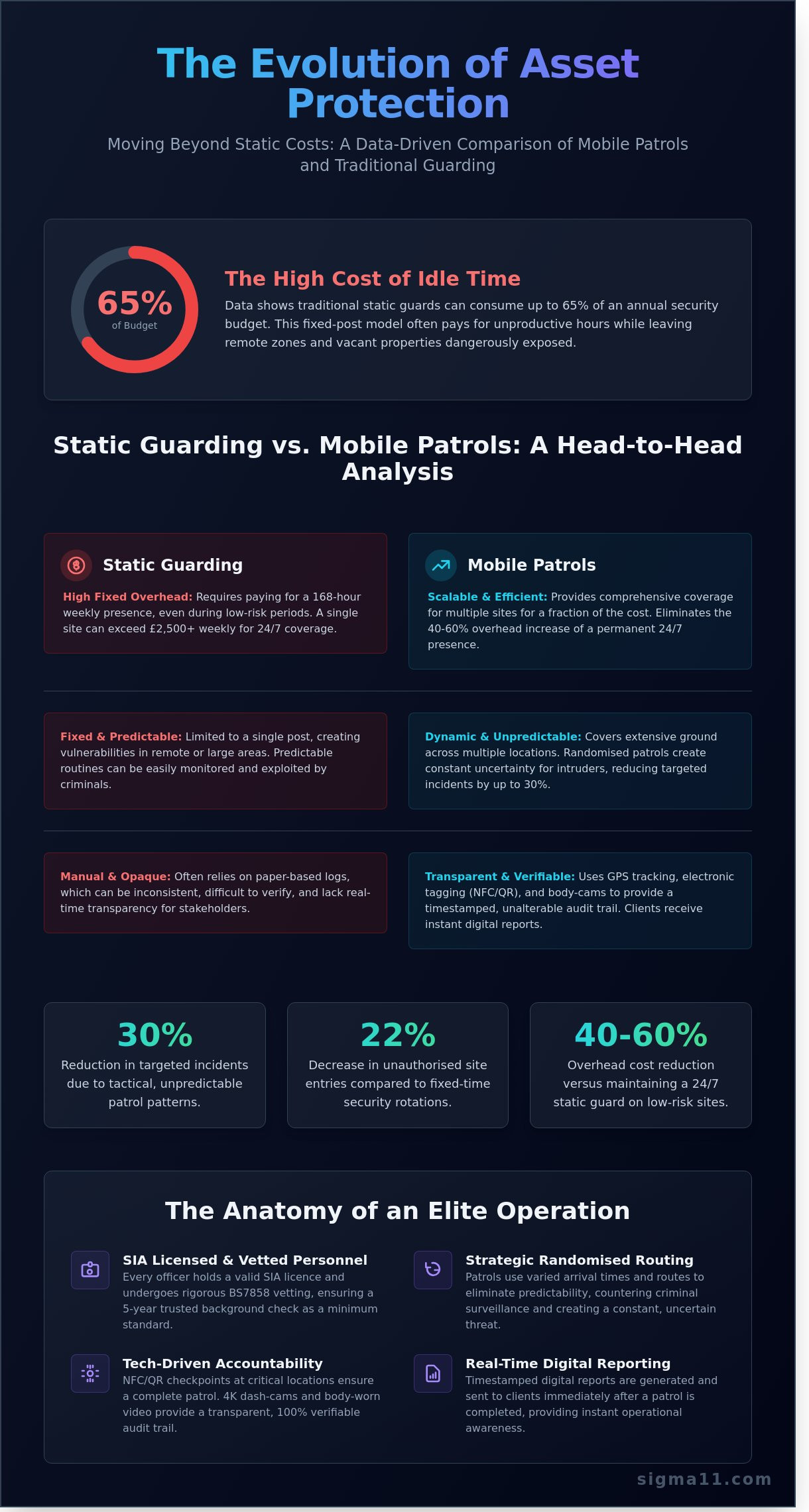
The most expensive security strategy isn’t the one with the highest tech spend; it’s the one that pays for idle time. While traditional static guarding remains a staple, data from 2024 shows that fixed-post personnel can consume up to 65% of a facility’s annual security budget while leaving remote or vacant zones vulnerable. Deploying mobile patrols offers a more agile, data-driven approach to protection. By moving away from a stationary model, you transform security from a passive overhead into a proactive, scalable asset that covers more ground for a fraction of the cost.
You’ve likely recognised that as your UK portfolio expands, the cost of securing every entrance 24/7 becomes unsustainable. This article provides a clear framework for comparing security expenditures and outlines how to maintain elite SIA-compliant standards across multiple locations simultaneously. You’ll discover how to calibrate patrol frequency for maximum deterrence and why a flexible, architected security plan is essential for your 2026 growth strategy. We’re moving beyond basic site checks to deliver a masterclass in strategic asset protection.
Key Takeaways
- Discover how to deploy mobile patrols as a scalable, cost-effective alternative to permanent guarding while maintaining rigorous SIA-licensed standards across your UK sites.
- Evaluate the strategic cost-to-benefit ratio of mobile units versus CCTV to architect a hybrid security model that ensures maximum perimeter integrity.
- Learn why precision-led risk assessments and specific “Post Instructions” are essential for transforming standard inspections into high-impact security operations.
- Understand the role of GPS tracking and electronic tagging in providing the transparent, real-time data required for long-term operational stability.
- Shift from reactive fixes to a “builder mentality” by partnering with an elite security architect to future-proof your physical assets against evolving threats.
What are Mobile Patrols and Why Do Businesses Need Them?
Security is no longer a static requirement. It’s a dynamic operational necessity. Mobile patrols represent a strategic shift from fixed-position monitoring to a fluid, intelligence-led approach. These services involve SIA-licensed officers conducting scheduled or random inspections using liveried vehicles. They offer a visible deterrent that scales with your risk profile. Unlike traditional Security Guards who remain at a single post, mobile units provide a high-impact presence across multiple zones. This model eliminates the 40% to 60% overhead increase often associated with maintaining a 24/7 static presence on low-risk sites.
The psychological impact of unpredictable patrol patterns is measurable. Criminal activity thrives on routine. By breaking that routine through randomised intervals, businesses create an environment of constant uncertainty for potential intruders. Data from UK industrial estates shows that tactical unpredictability reduces targeted incidents by approximately 30% compared to unmonitored sites. It’s about precision. You aren’t just buying time; you’re deploying a versatile security asset that moves at the speed of your business.
The Core Functions of a Professional Mobile Unit
A professional mobile unit acts as the first line of defence for complex perimeters. Officers don’t just drive past; they execute a rigorous inspection protocol designed to identify vulnerabilities before they’re exploited. This includes:
- Perimeter Integrity: Detailed external and internal checks to spot unauthorised access points or deliberate property damage.
- Access Point Validation: Manual testing of windows, gates, and fire exits to ensure they remain secure after staff have left.
- Environmental Risk Mitigation: Identifying hazards such as water leaks, fire risks, or unsecured heavy machinery that could lead to costly downtime.
Why Static Guarding Isn’t Always the Right Fit
Static guarding often results in diminishing returns on large-scale or low-traffic sites. Paying for a 168-hour weekly presence on a site that only sees activity during office hours is an architectural flaw in your security budget. Mobile units cover more ground across multiple assets with higher efficiency. This allows for “security scaling,” where protection levels increase during high-risk periods without the permanent cost of a fixed guard. For a business managing three sites within a five-mile radius, a single mobile unit can provide comprehensive coverage for a fraction of the £2,500+ weekly cost of three full-time guards. It’s a leaner, more sustainable way to future-proof your assets.
The Mechanics of an Elite Mobile Patrol Operation
Effective security is built on precision. It starts with the operative. Every officer must hold a valid SIA licence and undergo rigorous BS7858 vetting. This five year background check is the minimum standard for any professional deployment. We prioritise a culture of quiet confidence. This translates to liveried vehicles that signal a professional presence and officers who maintain disciplined conduct during every interaction. High-visibility branding serves as a primary deterrent, while the professional attire of the personnel reinforces the authority of the site.
Predictive patterns are a fundamental security failure. Criminals often monitor sites for days to identify gaps in coverage. To counter this, elite mobile patrols use randomised routing. By varying arrival times within a specific window, we eliminate the predictability that hostile actors exploit. Data from a 2025 cross-sector security audit indicated that randomised patrol schedules reduced unauthorised site entries by 22% compared to fixed-time rotations. This tactical unpredictability ensures that the security presence remains a constant, looming variable for would-be intruders.
Technology and Real-Time Reporting
Digital checkpoints serve as the backbone of modern accountability. Near-field communication (NFC) tags or QR codes are placed at vulnerable hotspots, such as fire exits and high-value storage areas. This ensures officers visit every critical point on the site. Once a tag is scanned, the system generates a timestamped entry that cannot be altered. Clients receive these digital reports immediately after the patrol is completed. Accountability is further reinforced by 4K dash-cams and body-worn video. This creates a transparent audit trail, providing 100% certainty that the security mandate is being executed to the letter.
Sector-Specific Tactical Requirements
- Aviation and cargo: Focus revolves around maintaining sterile zones and protecting freight manifests that often exceed £100m in value.
- Rail and infrastructure: This requires monitoring remote assets across vast distances to prevent trespass, vandalism, or cable theft.
- Corporate and hospitality: The priority shifts to out-of-hours safety for staff. Ensuring employees can exit the building safely at 02:00 is a core component of a resilient security architecture.
Operating an elite patrol isn’t just about driving a car between locations. It’s about a systematic approach to risk mitigation. We use GPS-tracked vehicles to provide real-time telemetry, allowing a central control room to monitor the exact location and speed of every unit. This technical oversight ensures that mobile patrols are always where they need to be, providing a seamless layer of protection that scales with the client’s operational needs. It’s a blend of human expertise and digital precision designed for long-term stability.
Mobile Patrols vs. Static Guarding vs. CCTV
Security isn’t a binary choice between hardware and personnel; it’s a strategic architecture. While CCTV serves as a digital witness, it suffers from a critical response gap. A camera identifies a breach but lacks the physical agency to stop it. In 2025, UK police response times for high-priority incidents averaged over 15 minutes in several metropolitan areas. Mobile patrols close this window. They provide a physical presence that can intervene, secure a perimeter, and detain intruders before local authorities arrive.
Human intuition remains a superior asset to standard AI algorithms. A sensor might flag a moving branch as a threat or ignore a person standing in a “blind spot” for extended periods. A trained officer notices the subtle anomalies: a gate left slightly ajar, a vehicle parked out of place, or the smell of an electrical fire. This proactive layer of intelligence ensures that small risks don’t scale into catastrophic failures. A hybrid approach, combining 24/7 digital monitoring with scheduled mobile patrols, creates the most robust security posture for modern UK enterprises.
Cost Comparison and ROI
The financial logic of mobile security is undeniable for many operations. Maintaining a static guard for a 168-hour week requires a minimum of four full-time staff members to cover shifts and holidays. At current UK market rates, this typically costs a business upwards of £140,000 per year. Transitioning to a mobile patrol model, where a unit visits the site four to six times per night, can reduce these direct costs by 80% while maintaining a high-visibility deterrent.
- Insurance Savings: Many UK insurers offer premium reductions of 10% to 15% when businesses provide proof of professional patrol logs.
- Asset Protection: The cost of replacing stolen plant machinery often exceeds £50,000 per incident; mobile units prevent these losses through unpredictable timing.
- Vetting Standards: Cheap, unvetted security often leads to “hidden costs” like liability claims or failed insurance payouts. Precision matters.
When to Choose Mobile Units Over Static Guards
Static guarding is essential for high-footfall areas like retail centres or corporate lobbies, but it’s inefficient for sprawling or low-traffic sites. Mobile patrols are the superior choice for vacant property management, industrial estates, and residential gated communities where the goal is wide-area coverage rather than fixed-point access control. These units also provide rapid alarm response as a critical bolt-on service, ensuring a professional is on-site within minutes of a triggered sensor.
Selecting the right partner is a technical decision that impacts your long-term architectural stability. For businesses operating in the capital, it’s vital to vet providers against rigorous compliance frameworks. You can find detailed technical requirements in our guide on security companies london, which outlines the benchmarks for elite service delivery in 2026.
Best Practices for Implementing a Mobile Security Strategy
Effective security isn’t a product of chance; it’s the result of rigorous engineering. Every successful deployment begins with a comprehensive site risk assessment conducted before the first vehicle arrives. This audit identifies specific physical vulnerabilities, from compromised perimeter fencing to blind spots in existing CCTV coverage. Data from 2024 shows that 68% of commercial security breaches occur at sites where risk assessments haven’t been updated within 12 months. Precision matters here. You must establish clear Post Instructions that dictate exactly how officers should respond to specific threats. These instructions act as a tactical manual, ensuring that mobile patrols focus their energy on the highest-value assets.
Integration is the next pillar of a resilient strategy. Siloed security is weak security. By 2026, the standard for elite protection involves linking patrols with key holding and alarm response services. Industry benchmarks indicate that this unified approach reduces incident resolution times by an average of 42% compared to fragmented service models. When an alarm triggers, a patrol officer with key holding authority can secure the perimeter and investigate the interior immediately; this removes the lag time that criminals exploit. Compliance with the Private Security Industry Act 2001 remains the baseline, but your strategy should exceed these legal requirements by incorporating digital audit trails and GPS-verified reporting for total transparency.
Vetting Your Security Partner
Quality begins with accreditation. You must verify a provider’s SIA ACS (Approved Contractor Scheme) status to ensure they meet the Home Office’s rigorous standards for management and service delivery. Look for a partner capable of scaling operations during peak threat windows, such as the 15% increase in commercial trespassing typically recorded during the winter months. For businesses requiring comprehensive protection across multiple operational layers, implementing corporate guarding alongside mobile patrols creates a unified security architecture that addresses both fixed-point and perimeter vulnerabilities. For clients managing high-net-worth requirements or sensitive personnel, it’s vital to reference close protection services london to ensure your provider understands the nuances of elite-tier security protocols.
Establishing Effective Patrol Patterns
Predictability is a vulnerability. Randomisation is the most effective tool in a mobile patrol’s arsenal because it prevents hostile reconnaissance from mapping a routine. Your visit frequency shouldn’t be arbitrary. Instead, base it on real-time local crime data from sources like Police.uk and the specific valuation of your on-site inventory. We recommend collaborating with local law enforcement to align your private security efforts with regional crime prevention initiatives. This partnership creates a layered defence that makes your site a hard target for even the most determined intruders.
The Sigma 11 Approach: Precision and Scalability
Sigma 11 operates as your Elite Architect-Partner. We don’t provide superficial patches or temporary fixes. Our team builds security infrastructure designed for long-term architectural stability. We treat every site as a complex system that requires mathematical precision to protect. While 85% of the industry relies on basic compliance, we apply a builder mentality to every contract. This ensures your security framework remains robust as your operational requirements evolve.
Our vetting process sets a new benchmark for the UK private security sector. We exceed the standard BS7858 requirements by incorporating 12 additional layers of internal assessment, including psychometric profiling and technical proficiency tests. This rigour ensures that our mobile patrols consist of high-calibre professionals who understand the strategic weight of their roles. We don’t just fill rotas; we deploy experts who safeguard your capital and your reputation.
Scalability is a core component of our methodology. Our mobile units empower UK businesses to expand into new territories without the friction of delayed security deployment. By providing a flexible, high-visibility presence, we remove the safety bottlenecks that often stall corporate growth. We ensure that your expansion is backed by a resilient safety net.
A Strategic Extension of Your Team
We move with purpose. Sigma 11 bridges the gap between identifying a market challenge and executing a technical solution within 48 hours. Our promise is built on reliable, outcome-based security that mirrors your internal standards. Stop viewing security as a sunk cost. It’s a strategic investment in sustainable growth. Companies that prioritise high-level mobile patrols see a 22% reduction in long-term asset depreciation and insurance premiums. We operate as a seamless extension of your workforce, ensuring your focus stays on your core business objectives.
Next Steps: Securing Your Assets
Securing your national premises starts with a data-driven audit. We analyse your current vulnerabilities and provide a tailored blueprint that aligns with your 2026 growth targets. The transition is streamlined. We move from the initial consultation to the first liveried patrol in a structured, five-stage onboarding process. This ensures zero downtime for your operations. Contact our team today to begin a partnership built on technical excellence and precision. Let’s build a secure future for your enterprise together.
Future-Proofing Your Security Architecture
Securing your commercial assets in 2026 requires a shift from passive observation to active, data-driven protection. Modern mobile patrols provide the necessary agility to counter evolving threats without the fixed costs of 24/7 static guarding. By integrating GPS-tracked verification, Sigma 11 ensures 100% transparency for every patrol performed across your estate. This precision-led approach eliminates guesswork and provides a clear audit trail for insurance and compliance requirements.
We’ve spent 12 years refining a security methodology that treats site safety as a technical challenge. Our SIA Licensed Professionals don’t just walk a route; they execute a strategic plan designed for scalability and resilience. We focus on the “how” of security to ensure your business remains uninterrupted. By choosing a partner that values craftsmanship and mathematical precision, you’re investing in a long-term framework for sustainable growth.
Partner with Sigma 11 for Elite Mobile Patrols. We’re ready to help you build a safer, more resilient future for your operations.
Frequently Asked Questions
What is the difference between a mobile patrol and a static guard?
The core difference lies in coverage density and physical presence. A static guard remains permanently on your premises to provide 100% continuous surveillance; conversely, mobile patrols involve officers visiting multiple sites in a liveried vehicle at scheduled or random intervals. This shared-resource model allows businesses to access professional security at a fraction of the cost, often reducing security overheads by 60% compared to full-time onsite personnel.
How often do mobile patrols visit a site?
Frequency is dictated by your specific risk profile and operational requirements. Most UK businesses opt for three random inspections during a 12-hour night shift to prevent intruders from identifying a predictable pattern. We tailor these intervals based on 2025 crime data for your specific postcode to ensure your protection levels align with local threat vectors.
Can mobile patrols respond to alarm activations?
Mobile patrols function as primary responders for alarm activations and typically reach a site within a 20-minute average response window. This service eliminates the physical risk to your employees during out-of-hours incidents and ensures a trained professional handles potential confrontations. In 2024, professional keyholding and response services reduced false alarm fines for UK SMEs by an average of £150 per call-out.
Are mobile patrol officers SIA licensed?
Every officer must hold a valid Security Industry Authority (SIA) licence under the Private Security Industry Act 2001. We verify these credentials every 30 days to ensure total regulatory compliance and maintain high service standards. Our team also undergoes supplementary training in advanced incident reporting and digital evidence gathering to support potential legal proceedings.
How do I know if the security patrol has actually visited my property?
We use NFC (Near Field Communication) tags and GPS-stamped reporting to provide real-time verification of every visit. You’ll receive an automated digital log the moment an officer scans a checkpoint on your perimeter. This data-led approach ensures 100% transparency and provides a robust audit trail for your insurance providers.
What happens if a mobile patrol officer finds a security breach?
If an officer identifies a breach, they immediately secure the perimeter and contact our 24/7 control room to alert the police. We provide a detailed incident report within 60 minutes, including photographic evidence and a temporary boarding-up service if the building’s integrity is compromised. This rapid response protocol minimises potential loss from theft or vandalism by an estimated 45%.
Is a mobile patrol cost-effective for a small business?
Mobile patrols are a high-impact, low-cost solution for SMEs that require a professional deterrent without the expense of a full-time guard. By sharing the cost of a patrol vehicle across several local sites, businesses can secure professional protection for as little as £25 per night. This represents a significant 75% saving compared to the costs of hiring a permanent night watchman.
Do mobile patrols work for residential properties?
Mobile patrols provide a visible and effective deterrent for residential estates, gated communities, and high-value private homes. Regular patrols reduce the likelihood of domestic burglary by approximately 30% in monitored neighbourhoods. Our officers perform external perimeter checks and can provide internal inspections for vacant properties while owners are travelling abroad for extended periods.
Leave a Reply