



Your SIA licence isn’t a career strategy; it’s simply a permit to enter an increasingly crowded room. With over 15,000 active Close Protection licences currently issued in the UK, the gap between holding a badge and securing elite close protection jobs london has never been wider. You’ve likely felt the frustration of investing upwards of £3,500 in tactical training only to find that the most lucrative contracts remain locked behind opaque, word-of-mouth networks. It’s a common bottleneck where high-calibre operators find themselves stalled by a lack of clear architectural progression.
We’re here to change that trajectory by treating your career as a scalable asset. This guide provides the strategic blueprint to bypass the noise and position yourself as a high-value partner for family offices and corporate entities. You’ll master the specific 2026 certification stacks that actually drive salary growth and learn the reputation-building protocols that turn a one-off task into a long-term principal relationship. We’ll break down the transition from reactive security to proactive risk management, ensuring your professional growth is both sustainable and measurable in the metropolitan market.
Key Takeaways
- Analyse the evolving metropolitan landscape to identify high-growth sectors within corporate security and private wealth.
- Master the essential SIA licensing requirements and BS7858 vetting standards to ensure full regulatory compliance and professional integrity.
- Integrate technical specialisms such as advanced medical response and surveillance to act as force multipliers for your professional market value.
- Navigate the hidden market for close protection jobs london by leveraging strategic networking and elite recruitment partnerships.
- Develop a sustainable career architecture that prioritises long-term growth and future-proofs your role within the elite security sector.
Understanding the Metropolitan Market for Close Protection Jobs London
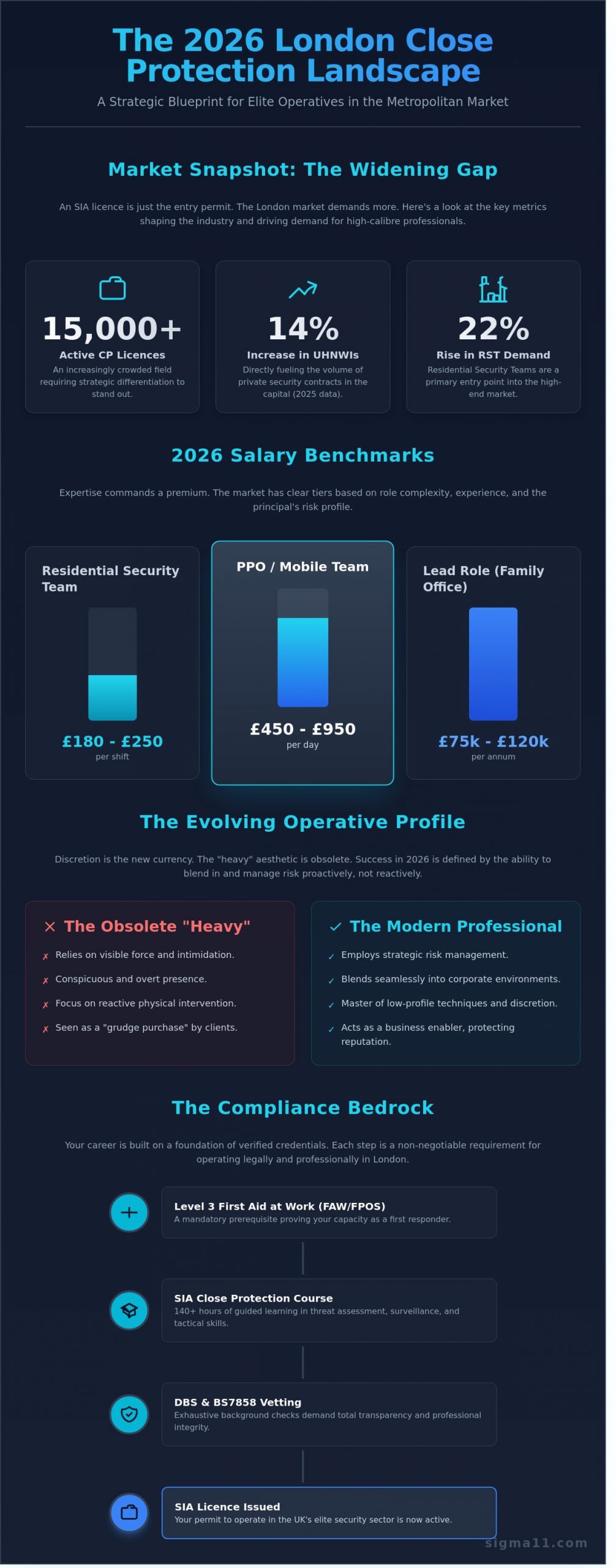
London remains the primary hub for high-end security services in Europe. By 2026, the demand for close protection jobs london has shifted toward a more integrated, intelligence-led model. Data from 2025 indicated a 14% increase in the number of Ultra-High-Net-Worth Individuals (UHNWIs) residing in the capital, directly impacting the volume of private security contracts. This growth isn’t limited to residential areas like Kensington or Mayfair. It extends to the City’s corporate suites and the tech corridors of East London.
The market has moved away from legacy “man-guarding” toward sophisticated executive protection. Clients now view security as a business enabler rather than a grudge purchase. The modern landscape requires a deep understanding of the duties of a close protection officer, moving beyond simple physical presence to proactive threat mitigation and technical surveillance counter-measures. This transition ensures that security infrastructure scales alongside the client’s global footprint.
Salary benchmarks for 2026 reflect this heightened requirement for expertise. You’ll find that entry-level Residential Security Team (RST) roles start at £180 to £250 per shift. Experienced operatives working on mobile teams or as personal protection officers (PPOs) command daily rates between £450 and £950. Permanent annual salaries for lead roles within family offices now range from £75,000 to £120,000, depending on the complexity of the principal’s lifestyle and travel schedule.
The Evolving Profile of the Modern Operative
The “heavy” aesthetic is obsolete. Modern clients prioritise operatives who blend into professional environments. Strategic risk management has replaced visible force as the primary tool. You’ll need refined soft skills, impeccable etiquette, and the ability to operate within corporate boardrooms. Discretion is the most valuable currency in 2026. Operatives who master low-profile protection techniques are securing the highest-paying contracts because they protect the client’s reputation as much as their physical safety.
Market Drivers and Sector Specialisation
Diplomatic protection and corporate executive suites remain the most stable sectors. However, Residential Security Teams (RST) serve as the most common entry point for those transitioning from military or police backgrounds. We’ve seen a 22% rise in demand for RST services as part of holistic “safe house” packages. International travel logistics also drive local job availability. London’s status as a global aviation hub means many close protection jobs london involve short-term, high-intensity deployments that start at private terminals like Farnborough or Northolt.
Essential SIA Licensing and Regulatory Compliance Standards
Compliance is the bedrock of the private security industry. To secure close protection jobs london, you must possess a valid Security Industry Authority (SIA) Close Protection licence. This isn’t merely a bureaucratic hurdle; it’s a verification of your tactical and ethical readiness. The SIA mandate ensures that every operative within the capital meets a standardised level of proficiency. This regulatory framework is supported by the Disclosure and Barring Service (DBS), which conducts exhaustive criminal record checks. High-level security clearance demands total transparency. Any undisclosed criminal history or gaps in your record will terminate an application immediately. Precision in your documentation reflects the precision required in the field.
Securing Your SIA Close Protection Licence
The path to licensing requires completing a rigorous training course, typically involving 140 hours of guided learning. The curriculum focuses on critical modules such as threat assessment, surveillance awareness, and tactical driving techniques. You can review the National Careers Service Bodyguard Profile to understand how these skills translate into daily operational duties. Beyond tactical training, you must hold a valid Level 3 First Aid at Work (FAW) qualification or a higher equivalent like First Person on Scene (FPOS). Professionals often use a sia security licence check to verify their standing and ensure their credentials remain active before applying for high-stakes contracts.
Vetting and Background Architectural Stability
In the world of elite protection, “vetted” is the most significant word on your CV. Employers rely on the BS7858 standard to screen personnel. This process involves a meticulous 5-year or 10-year employment history verification, leaving no room for ambiguity. We view this vetting as a form of human architectural stability; it ensures the foundation of a security team is sound. Professional agencies like Sigma 11 maintain these rigorous standards to ensure that security companies london provide only the most reliable operatives to their clients. This level of scrutiny protects the reputation of the firm and the safety of the principal. If you’re looking to scale your career, you’ll find that our strategic approach to security personnel prioritises those who treat compliance as a craft rather than a chore. Consistency in your professional history is the ultimate indicator of future performance. An unblemished record doesn’t just satisfy a regulator; it builds the trust necessary for long-term partnerships in the London market.
Technical Specialisms for Elite Protection Roles
Basic compliance is the floor. Excellence is the ceiling. Operatives seeking the most lucrative close protection jobs london offers must develop “force multipliers.” These are niche technical skills that transform a guard into a strategic asset. By 2026, the market will demand more than physical presence; it will demand multi-functional expertise. Meeting the baseline SIA Licensing Requirements is just the start. High-tier contracts in Mayfair and the City require specialised certifications that prove your value under pressure.
Advanced Medical and Tactical Driving Skills
Medical proficiency is a primary differentiator. A First Response Emergency Care (FREC) Level 3 qualification is now a standard expectation for high-net-worth (HNW) details. Progressing to Level 4 can increase your daily rate by an average of £50 to £100. Tactical driving follows a similar logic. Qualifications from RoSPA or IAM RoadSmart aren’t just badges; they represent a commitment to risk mitigation. An operative who can provide advanced trauma care and execute precision evasive manoeuvres reduces the client’s headcount needs. You become the driver and the medic. This efficiency secures long-term, high-value placements.
Surveillance and Technical Counter-Surveillance
Proactive security relies on information. Surveillance skills allow teams to identify threats before they reach the principal. In the corporate sector, Technical Surveillance Counter-Measures (TSCM) are increasingly vital. Clients fear corporate espionage as much as physical harm. Operatives who understand Radio Frequency (RF) detection and physical “bug” sweeps offer a level of digital and physical hygiene that basic teams lack. Integrating technical fluency into your security stack isn’t optional. It’s how you future-proof your career when applying for close protection jobs london.
Continuous Professional Development (CPD) is the engine of career growth. The UK security sector sees a 15% increase in salary for operatives who complete at least two advanced technical courses annually. Specialisation allows you to move away from ad-hoc tasking into stable, multi-year contracts. To scale effectively, focus on these core pillars:
- Medical: FREC 3/4 or Tactical Combat Casualty Care (TCCC).
- Mobility: RoSPA Gold or IAM RoadSmart Advanced Driver certification.
- Intelligence: Open Source Intelligence (OSINT) and TSCM basics.
Focus on craftsmanship. Build a portfolio of skills that makes you indispensable to the principal’s lifestyle and business operations. Precision wins contracts. Stability follows expertise. We don’t just fill roles; we build architectural security solutions that last.
Strategic Networking and Career Development
The most lucrative close protection jobs London offers are rarely found on public platforms. By 2026, industry data suggests that 85% of tier-one security placements occur within private circles or through specialist headhunters. You’ve got to look beyond generic job boards to access the hidden market of elite protection. This transition requires a strategic mindset. Build a professional network that includes experienced peers, specialist agencies, and former clients who value your craftsmanship.
Your digital presence must reflect architectural precision. It isn’t about being seen everywhere; it’s about being validated by the right people. Treat your LinkedIn profile and professional portfolio as a high-performance interface. Keep it clean, updated, and strictly professional. Discretion is your most valuable asset. Avoid oversharing operational details that could compromise client safety or your own reputation. A professional digital footprint should signal reliability without sacrificing the privacy that high-net-worth individuals demand.
Building Professional Reputation and Trust
Word-of-mouth remains the primary currency in the London security sector. Trust is built through years of quiet, reliable service. In the HNW (High Net Worth) space, 100% of contracts now include rigorous non-disclosure agreements. These aren’t suggestions; they’re legal and ethical mandates. Discretion is the calculated ability to remain invisible while maintaining total situational control. If the public knows who you’ve worked for, you haven’t done your job correctly.
Accessing High-Value Contracts
High-end agencies providing close protection services london look for operators who fit a specific profile. Approach these firms with a minimalist CV that focuses on outcomes and technical certifications. Focus on your ability to scale security protocols to meet evolving threats. Specialist recruitment agencies act as the gatekeepers to the city’s most secure environments, so treat every interaction as a technical interview.
- Contractual Basis: Provides variety and a higher day rate, often exceeding £550 for elite tasks in the 2026 market.
- Permanent Household: Offers long-term stability and benefits, with 2026 salaries for lead roles reaching £90,000 per annum.
The UK security landscape is increasingly dominated by firms that value long-term architectural stability over quick fixes. Whether you choose the flexibility of contracting or the depth of a permanent role, your focus must remain on the precision of your execution. This disciplined approach ensures you aren’t just finding a job, but building a sustainable career.
Professional Recruitment and Vetting Partnerships
Finding the right close protection jobs london offers in 2026 requires a shift in mindset. You aren’t just looking for a shift; you’re looking for a career architecture. Sigma 11 acts as the strategic bridge between elite personnel and high-compliance industries. We specialise in staffing solutions where the margin for error is zero. Our ecosystem extends beyond traditional security into critical infrastructure, including aviation and rail sectors. This cross-sector mobility ensures our partners remain resilient against market fluctuations and shifting security landscapes. We invite qualified professionals to join a network built on the principles of craftsmanship, technical excellence, and absolute reliability.
Why Vetted Professionals Choose Sigma 11
Sigma 11 brings 11 years of operational experience to the professional personnel sector. We operate under the “Elite Architect-Partner” model, prioritising long-term architectural stability over quick fixes. Our commitment to future-proofing means we provide exposure to multiple high-security sectors, ensuring your skills remain relevant through 2026 and beyond. We value the builder mentality. Professionals choose us because we offer a level of precision and discipline that mirrors their own high standards. We don’t just manage careers; we accelerate them within a framework of sustainable growth.
Next Steps for Your Security Career
Securing top-tier close protection jobs london starts with personal brand alignment. Your professional profile must reflect the standards of excellence required by high-net-worth clients and corporate entities. When preparing for a vetting interview, focus on your track record of reliability and your technical adaptability. We value directness and a results-driven approach.
- Audit your credentials: Ensure all certifications meet the updated 2026 regulatory standards for London-based operations.
- Refine your narrative: Highlight specific instances where you’ve managed complex technical challenges or high-compliance environments.
- Connect with experts: Visit the Sigma 11 contact portal to begin the professional placement process.
We’re looking for experts who are passionate about solving difficult problems and who value precision as much as innovation. Align your career with a partner that treats security as a craft. Your next professional milestone starts with a commitment to these elite standards.
Architecting Your Future in London’s Security Sector
The landscape for close protection jobs london in 2026 demands more than just physical presence; it requires a strategic blend of SIA regulatory compliance and advanced technical specialisms. Professionals must maintain strict adherence to BS7858 vetting standards to remain competitive in a market that values precision over volume. Success depends on building a career that scales alongside the shifting demands of the capital’s high-stakes environments. You’ve seen how technical fluency and strategic networking form the bedrock of a sustainable career in elite protection.
Sigma 11 brings over 10 years of experience to the professional security and staffing sector, providing a bridge between elite talent and complex operational needs. We apply strategic expertise across the security, aviation, rail, and care sectors to ensure seamless integration. Our approach focuses on long-term stability rather than quick fixes. Partner with Sigma 11 for elite security and professional staffing solutions. We’ll help you navigate the rigorous vetting and regulatory requirements of the 2026 market with quiet confidence. Precision is the foundation of every successful career in protection. Your next professional milestone is within reach.
Frequently Asked Questions
What qualifications do I need for close protection jobs in London?
You must hold a valid SIA Level 3 Certificate in Close Protection and a recognised first aid qualification like First Response Emergency Care (FREC 3). In 2026, the Security Industry Authority requires 140 hours of guided learning for this licence. These standards ensure you can manage physical intervention and surveillance. Most elite London firms also demand a full UK driving licence with advanced driving certifications like RoSPA or IAM.
How much can a Close Protection Operative earn in the UK?
A Close Protection Operative in the UK typically earns between £250 and £500 per day for contract work. For those in permanent residential roles, salaries often range from £45,000 to £85,000 per year depending on the risk profile. High-net-worth clients in Mayfair or Knightsbridge may pay premiums exceeding £600 per day for specialised skill sets. These figures reflect the high level of responsibility required for close protection jobs london.
Is an SIA licence mandatory for all private security roles?
Yes, an SIA licence is a legal requirement for anyone performing front-line private security duties under the Private Security Industry Act 2001. Working without a valid licence is a criminal offence that carries a maximum penalty of 6 months in prison and a £5,000 fine. The licence serves as a baseline for professional standards. It confirms you’ve passed the necessary background checks and met the industry’s training benchmarks.
How do I transition from the military to private close protection?
Transitioning from the military requires translating your tactical skills into a corporate security framework using ELCAS credits for funding. You should focus on the 2026 industry shift toward intelligence-led protection rather than just physical presence. Network with established firms and attend industry events to build a civilian reputation. Most successful veterans leverage their discipline while adopting the softer communication skills essential for high-end client interactions in the capital.
What is the difference between a bodyguard and a Close Protection Operative?
The term bodyguard is a colloquialism, while Close Protection Operative is the professional designation used within the UK security industry. A CPO manages a comprehensive security ecosystem that includes threat assessments, route planning, and technical surveillance. Bodyguards are often perceived as mere physical deterrents. In contrast, a CPO operates as a strategic partner, ensuring the client’s lifestyle remains uninterrupted through meticulous logistics and proactive risk mitigation.
What does the BS7858 vetting process involve for security staff?
The BS7858 vetting process is the British Standard for screening individuals working in a secure environment. It requires a full 5-year employment and education history with no gaps longer than 31 days. You’ll also undergo a credit check to identify financial vulnerabilities and a criminal record check through the Disclosure and Barring Service (DBS). Firms use this rigorous 6-stage verification process to ensure every operative is reliable and trustworthy.
Can I work in close protection without previous police or military experience?
You can enter the industry without a military or police background, though you’ll need to demonstrate exceptional technical skills and professional maturity. Approximately 30% of new entrants now come from diverse professional backgrounds like corporate logistics or hospitality. Success depends on obtaining high-tier certifications and gaining experience in entry-level security roles first. Building a portfolio of specialised skills, such as cyber security, makes you highly competitive for close protection jobs london.
How do I find reputable close protection companies in the UK?
You can find reputable firms by searching the SIA Approved Contractor Scheme (ACS) database, which currently lists over 700 verified businesses. Look for companies with high ACS scores and those that hold ISO 9001 certification for quality management. Researching the Circuit Magazine or attending the Close Protection Conference provides insights into industry leaders. Focus on firms that prioritise long-term architectural stability in their security planning rather than those offering temporary, low-cost solutions.
Leave a Reply