



What if the most difficult part of securing a role at the UK’s busiest transport hub isn’t the high-stakes security work, but the 15-week administrative gauntlet required to get through the door? For many applicants, the path to heathrow security jobs feels like a black box of opaque vetting procedures and rigorous compliance standards. You likely understand that precision is non-negotiable in aviation, yet the challenge of documenting a flawless five-year employment history often stalls promising careers before they even begin.
We believe in a builder’s approach to career progression. This guide eliminates the guesswork by providing a strategic roadmap to master the recruitment lifecycle. You’ll gain the technical clarity needed to navigate the Virtual Assessment Centre and the practical insights to excel in daily security operations. By the end of this article, you’ll have a disciplined plan to secure your vetted position and future-proof your career in the 2026 aviation landscape. We’ll break down the exact behavioural standards and documentation milestones required for a successful, long-term placement.
Key Takeaways
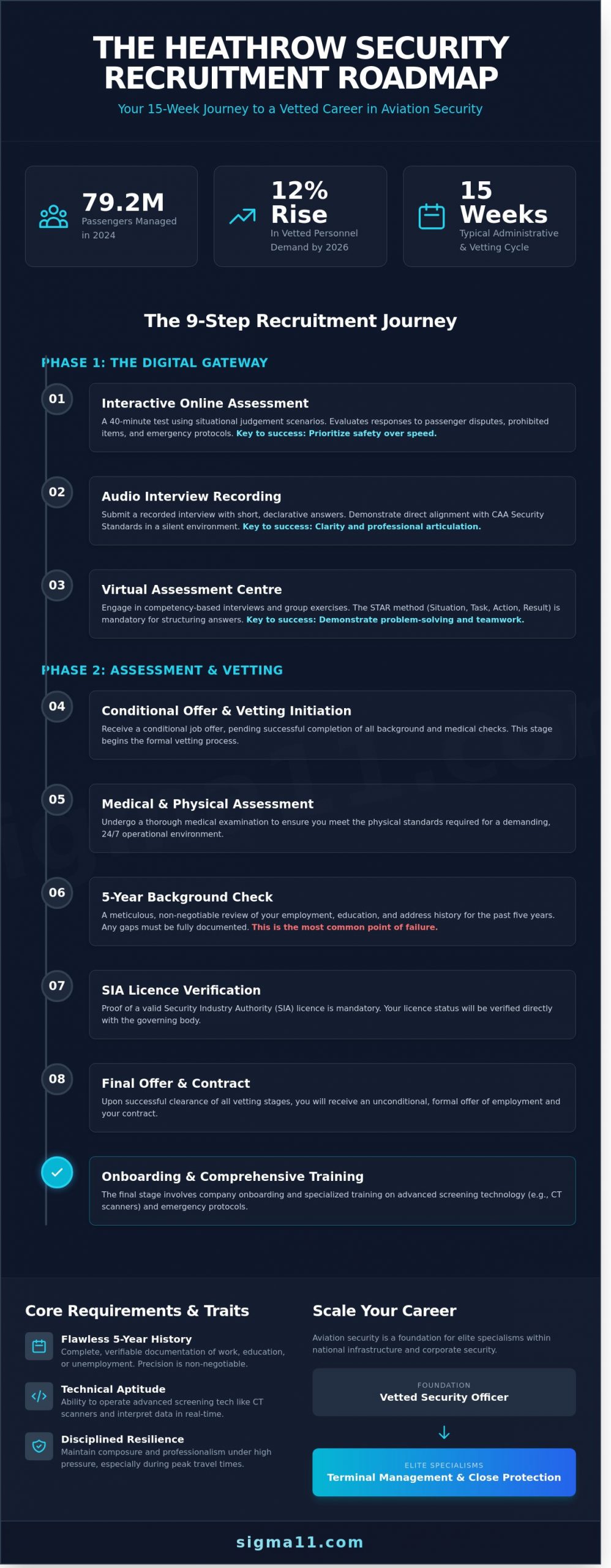
- Navigate the complex 15-week recruitment cycle by mastering each of the nine critical stages, from initial interactive assessments to final vetting.
- Understand the stringent five-year background checks and SIA licence requirements essential for securing heathrow security jobs in a high-stakes aviation environment.
- Align your professional standards with the operational demands of a 24/7 global hub, ensuring long-term resilience within national infrastructure.
- Discover how to scale your career from a foundation in aviation security toward elite specialisms, including terminal management and Close Protection services.
Understanding the Landscape of Heathrow Security Jobs
Heathrow operates as a primary engine for the UK economy. In 2024, the airport managed 79.2 million passengers, a figure set to grow as the industry scales toward 2026 targets. Securing this volume of human and capital flow requires more than standard guarding. It demands a sophisticated understanding of national resilience. Heathrow security jobs represent a front-line commitment to protecting the state’s most vital transport link. This isn’t retail loss prevention; it’s high-stakes infrastructure defence.
Aviation security operates under the strict UK Airport Policing Framework, which integrates private security teams with national law enforcement. By 2026, the sector expects a 12% rise in the demand for vetted personnel to manage new terminal expansions and increased flight frequencies. You aren’t just a guard. You’re a precision instrument in a complex logistics machine. This role requires balancing rigorous safety protocols with a flagship service mentality. Every interaction must be seamless, professional, and efficient to maintain the airport’s global reputation.
Core Responsibilities of a Security Officer
Precision is the standard. Officers manage advanced technological arrays, including next-generation CT scanners that streamline the screening of liquids and electronics. You’ll conduct high-visibility patrols across terminals 2 through 5, maintaining a vigilant presence in zones that often see 200,000 daily visitors. Coordination is vital. You’ll execute emergency protocols alongside the Metropolitan Police, ensuring rapid response to any breach of the sterile zone. Every shift involves a commitment to technical accuracy and proactive threat detection.
The Cultural Fit: What Recruiters Look For
Recruiters prioritise disciplined behaviour and technical aptitude. You need the ability to relay complex regulatory instructions in a friendly, authoritative tone. High-pressure environments are the norm here. During the 2025 summer peak, security teams managed record-breaking queues with zero compromise on safety. Resilience is non-negotiable. Successful candidates demonstrate a builder mentality, looking to scale their careers within a structured, high-performance environment. You’re expected to be a partner in the airport’s operational excellence, not just an observer on the perimeter.
The 2026 outlook for heathrow security jobs is one of growth and technological integration. As the airport adopts more biometric and AI-driven screening tools, the role of the security professional becomes more analytical. You’re tasked with interpreting data in real-time while providing a reassuring human presence. This balance of technical skill and interpersonal diplomacy defines the modern aviation security professional.
The 9-Step Recruitment Journey to Aviation Security
Securing one of the available heathrow security jobs requires more than a standard CV submission. It is a methodical technical evaluation designed to filter for precision, resilience, and high-level situational awareness. The recruitment process functions as a rigorous vetting engine. It ensures every officer on the frontline meets the exacting demands of a Tier 1 international hub. Candidates must navigate a multi-stage funnel that tests both cognitive ability and physical readiness.
Phase 1: The Digital Gateway
The journey starts with the 40-minute Interactive Online Assessment (IOA). This stage uses situational judgement tests to evaluate how you handle terminal pressure. You’ll face scenarios involving prohibited items, passenger disputes, and emergency protocols. Success requires a focus on safety over speed. Precision is the baseline. If you rush, you risk failing the behavioural consistency checks built into the software.
Following the IOA, you’ll record an audio interview. Clarity defines your profile here. Deliver short, declarative answers. Avoid industry jargon that obscures your meaning. Most rejections at this stage happen because candidates provide generic responses. You must demonstrate a direct alignment with the Civil Aviation Authority Security Standards which dictate the legal framework for all UK airport operations. Ensure your recording environment is silent. Technical interference can lead to an immediate disqualification based on the inability to assess your communication skills.
Phase 2: The Assessment and Offer
Advancing to the Virtual Assessment Centre demands a shift in strategy. You’ll engage in competency-based interviews where the STAR method is mandatory. Structure your answers by defining the Situation, Task, Action, and Result. High-performing candidates focus 60% of their response on the ‘Action’ phase to demonstrate their logic and builder mentality. The assessors are looking for evidence of discipline and the ability to scale your skills within a high-stakes environment.
The final hurdle is the 30-minute medical and physical review. This protocol is non-negotiable. It includes a colour vision test, a hearing assessment, and a manual handling check. You must be able to stand for long periods and lift up to 15kg repeatedly. Once you pass, the formal offer arrives. In 2026, these offers include a detailed breakdown of your 5-year background vetting requirements and a roadmap for your initial 6-week intensive training programme. As you prepare to join this elite workforce, consider how robust technical systems underpin the security infrastructure you’ll soon be managing. A formal offer is a partnership agreement. It signals that you’re ready to maintain the operational integrity of the UK’s busiest gateway.
Mastering the Vetting and SIA Licence Requirements
Precision defines the entry requirements for heathrow security jobs. The vetting process is a rigorous 14 to 15-week architectural build of your professional history. This timeline isn’t a bureaucratic delay; it’s a critical security protocol mandated by the Civil Aviation Authority (CAA). You must provide a comprehensive, 5-year chronological history with zero unverified gaps. Accuracy at this stage determines the speed of your deployment. Professionals who prepare their documentation in advance often reduce their onboarding time by 20%.
Securing Your 5-Year Employment History
Documentation is the foundation of your application. You’ll need an official employment history letter from HMRC, which details every tax contribution made over the last 60 months. If you’ve spent time in education or self-employment, prepare your certificates or tax returns early. Gaps exceeding 28 days require formal verification from a non-family professional. Honesty is non-negotiable. Any discrepancy in the Referencing & Vetting Form can lead to a permanent disqualification from airside roles. We treat this process with the same scrutiny as a technical audit, ensuring every date aligns with your National Insurance records.
The SIA Licence: A Prerequisite for Success
An active SIA licence serves as the baseline technical requirement for most heathrow security jobs. While various tiers exist, the Door Supervisor licence is the industry standard for terminal operations due to its versatility. You can initiate the SIA licence application process via the GOV.UK portal to ensure you’re ready for immediate placement. This licence acts as your professional credentials, which we then layer with specialised aviation security (AvSec) training.
Sigma 11 provides the strategic framework to bridge the gap between basic licensing and high-level airport deployment. We focus on candidates who demonstrate technical fluency and a disciplined approach to security protocols. Our methodology ensures that SIA-licensed professionals are not just present, but are fully integrated into the airport’s complex security infrastructure. We value long-term stability and craftsmanship in security, moving beyond superficial checks to build a robust, future-proof workforce for the UK’s busiest aviation hub.
- Request your HMRC history letter at least 3 weeks before applying.
- Identify two personal referees who have known you for over 5 years.
- Ensure your SIA licence has at least 6 months validity remaining.
- Document all overseas travel exceeding 6 months with official police certificates.
Daily Life and Professional Expectations in Aviation
Operating within Heathrow requires a mindset geared towards operational excellence and high-frequency precision. This environment functions as a 24/7 global engine, where every security officer acts as a vital node in a massive logistical network. Professionalism isn’t optional; it’s the baseline. You’ll maintain a sharp uniform and a disciplined presence, reflecting the security standards of a hub that managed 79.2 million passengers in 2023. This role demands a balance of technical rigour and human-centric service. You aren’t just a guard. You’re an essential component in a complex safety framework.
Shift Patterns and Work-Life Balance
The rhythm of heathrow security jobs is defined by rotation and resilience. Most teams operate on a shift pattern that includes early starts as early as 04:00, late finishes at 23:00, or dedicated night blocks. You’ll need to manage your energy levels across these cycles with the same discipline you apply to your security checks. The physical requirements are significant. Officers frequently cover 10 to 12 miles on foot during a single shift while patrolling terminals or managing high-volume queues. While the work is intense, the scale of Heathrow’s operations allows for robust overtime structures and structured career progression that many smaller airports cannot match. Successful candidates view these shifts as a way to build a flexible, long-term lifestyle within a stable industry.
Training and Skills Evolution
2026 marks a turning point in aviation technology. Security professionals now master advanced CT X-ray systems and automated tray return systems that have replaced older, slower methodologies. Your training isn’t a one-time event; it’s a continuous cycle of certification and scaling your expertise. You’ll undergo annual refresher modules to maintain compliance with Civil Aviation Authority (CAA) regulations. This ensures your technical stack remains current as threats evolve. Beyond the hardware, your ability to de-escalate conflict is paramount. You’ll learn to process diverse passenger groups with speed and empathy, ensuring that safety protocols never compromise the traveller experience. Handling 200,000 passengers daily requires a unique blend of technical fluency and emotional intelligence.
Precision in execution leads to long-term career stability. For those ready to scale their professional impact and master the complexities of aviation safety, view our strategic career growth pathways to understand how to transition from entry-level roles into specialist security management.
Scaling Your Career: From Security Officer to Elite Specialist
Securing a role within the UK’s busiest aviation hub isn’t a final destination; it’s a high-performance launchpad. Professionals who excel in heathrow security jobs develop a technical foundation that is nearly impossible to replicate in other sectors. You’re operating within a high-stakes environment that demands absolute precision, managing complex regulatory frameworks and high-volume passenger throughput daily. This rigorous training makes you an ideal candidate for lateral moves into specialised cargo security, canine handling, or terminal duty management.
By 2026, the demand for intelligence-led security roles is expected to grow by 15% across major UK transport hubs. Transitioning into these niches requires a commitment to continuous upskilling. For example, moving from a standard security officer role into cargo security involves mastering Department for Transport (DfT) protocols and advanced X-ray screening technologies. These specialists often command salaries 20% higher than generalist roles, reflecting the technical expertise required to protect global supply chains.
Aviation security also serves as the premier training ground for close protection services. The discipline required to monitor 80 million annual passengers translates directly to the high-end executive protection market. You learn to identify behavioral anomalies and mitigate risks before they escalate. It’s about proactive strategy rather than reactive force.
Building Your Professional Portfolio
Your time at Heathrow builds a portfolio of transferable skills that are highly valued in the corporate sector. When choosing security companies for your next career move, your experience with Tier 1 infrastructure will be your strongest asset. Focus on documenting your experience with conflict resolution, emergency response, and SIA compliance. Networking within the rail staffing and maritime sectors can also open doors to lucrative consultancy roles, where your knowledge of large-scale site logistics is a rare commodity.
The Sigma 11 Advantage
Sigma 11 doesn’t just fill vacancies; we build careers. We act as a strategic partner for security professionals looking to scale their impact across the UK. Our approach focuses on long-term viability and architectural stability in your career path. We provide:
- Direct access to a vetted network of high-tier roles in London and beyond.
- Expert guidance on maintaining SIA standards and evolving compliance requirements.
- A partnership model that prioritises your professional development and strategic deployment.
We believe in the builder mentality. Whether you’re aiming for a management position at Heathrow or looking to transition into executive protection, we provide the framework to ensure your growth is sustainable and your skills remain future-proof. We handle the complexity of career logistics so you can focus on mastering your craft.
Secure Your Future in Aviation
Success in the 2026 aviation landscape demands more than just a passing interest. You’ll need to master the 9-step recruitment journey and maintain strict compliance with SIA standards to stand out. Navigating heathrow security jobs requires a commitment to precision and a clear strategy for long-term career scaling. Whether you’re entering the workforce or transitioning into an elite specialist role, your focus should remain on technical excellence and professional stability.
Sigma 11 brings over 10 years of expertise to the aviation sector. We operate as a strategic partner for multi-sector staffing, ensuring every placement meets rigorous national vetting requirements. Our approach isn’t about quick fixes. We focus on building sustainable growth through disciplined placement and expert craftsmanship. We handle the complexities of the vetting process so you can focus on the mission at hand. It’s time to leverage our decade of experience to accelerate your professional trajectory.
Explore professional security opportunities with Sigma 11
Your path to a high-impact role at one of the world’s busiest hubs is ready for activation. Take the next step with confidence.
Frequently Asked Questions
Do I need an SIA licence to apply for Heathrow security jobs?
You don’t need a pre-existing SIA licence to apply for most Heathrow security jobs. Heathrow Airport Limited provides comprehensive, paid training that meets Department for Transport standards. Successful recruits undergo a 6-week training programme to earn their Ground Security Operative certification. This internal qualification allows you to perform aviation-specific security duties without an external SIA badge.
How long does the background vetting process actually take?
The background vetting process typically takes between 8 and 12 weeks to complete. This timeline is necessary to verify a continuous 5-year employment and education history without gaps exceeding 28 days. Delays often occur if previous employers don’t respond within the standard 10-day window. Precision is vital here to ensure compliance with Civil Aviation Authority security protocols.
What is the minimum age and nationality requirement for airport security?
Applicants must be at least 18 years old and possess the right to work in the UK. You also need to have resided in the United Kingdom for the last 3 consecutive years to pass the Counter-Terrorism Check. Heathrow requires a valid passport or a share code from the Home Office to verify your status. These strict criteria ensure all personnel meet national security benchmarks.
Can I apply if I have a criminal record or past cautions?
You can apply with a record, but specific disqualifying offences will result in an automatic rejection. Any conviction related to violence, theft, or dishonesty within the last 5 years usually bars entry. Heathrow conducts an Enhanced Disclosure and Barring Service check. You must disclose all cautions and convictions; non-disclosure is a primary reason for failing the vetting stage.
What happens during the Virtual Assessment Centre interview?
The Virtual Assessment Centre involves a 90-minute session featuring a group exercise and a competency-based interview. You’ll face situational judgment tests designed to measure your reaction to high-pressure terminal scenarios. Expect questions focused on the STAR method: Situation, Task, Action, and Result. This digital stage filters candidates based on their ability to maintain operational precision while delivering excellent passenger service.
Is there a specific uniform or dress code for security officers?
Heathrow provides a full professional uniform that you must wear according to strict grooming standards. Security officers receive trousers, shirts, a tie, and a high-visibility jacket for airside duties. You must provide your own black, polishable leather shoes that meet safety specifications. Maintaining a sharp appearance is mandatory to project authority and reliability within the airport environment.
How much can I expect to earn in an entry-level aviation security role?
Entry-level security officers at Heathrow can expect a starting salary package between £28,500 and £31,200 per annum. This figure includes a base wage plus a shift allowance for working early mornings, nights, and weekends. Overtime opportunities often increase total earnings by 15% for those looking to accelerate their income. These rates reflect the 2026 pay scales designed to attract top-tier talent to heathrow security jobs.
What is the HMRC 5-year history letter and why is it required?
The HMRC 5-year history letter provides official evidence of your employment and benefit claims since 2021. It’s required to verify any gaps in your CV that references can’t account for. You can request this document via your personal tax account on the GOV.UK website. It acts as a primary source of truth for the vetting team to confirm your activity history is transparent and secure.
Leave a Reply