



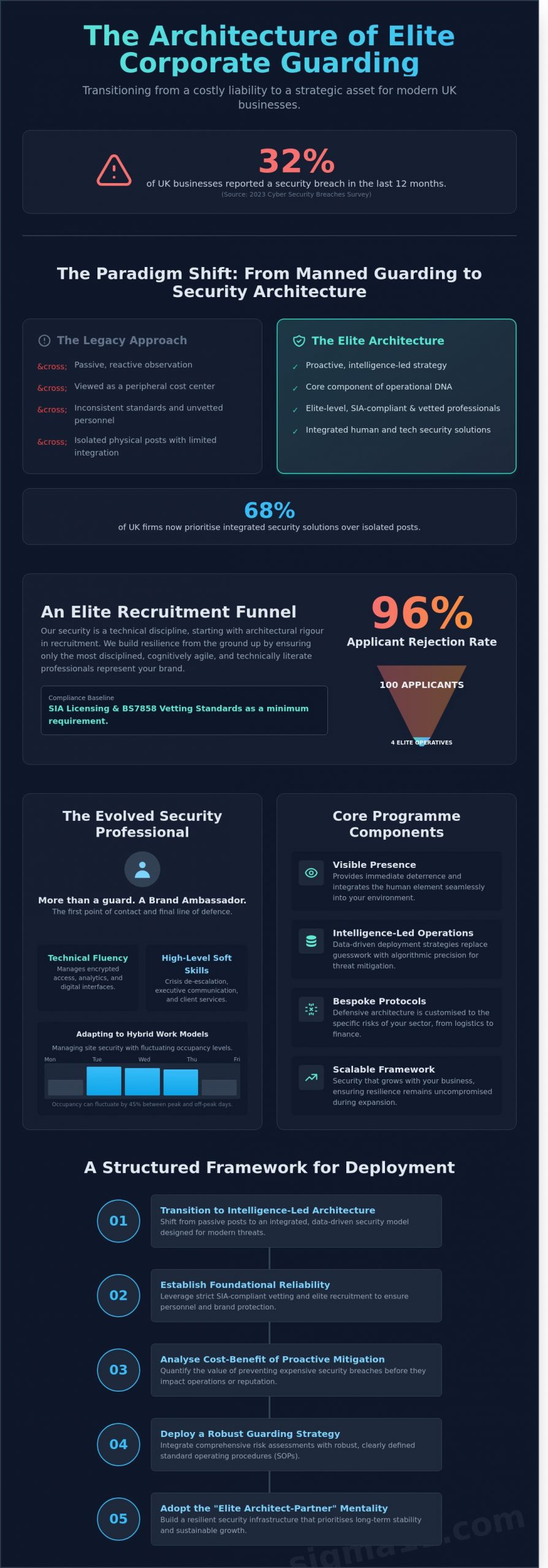
Your security budget is a wasted expense if it doesn’t function as a strategic asset. With 32% of UK businesses reporting a security breach in the last 12 months according to the 2023 Cyber Security Breaches Survey, the traditional model of low-cost, unvetted personnel is no longer a viable risk. Effective corporate guarding requires a shift from passive observation to an elite-level security architecture that’s built for resilience. It’s about precision engineering for your physical and operational perimeter.
You’ve likely felt the frustration of inconsistent standards or the nagging fear that a single SIA compliance oversight could devastate your hard-won brand reputation. We understand that security shouldn’t feel like an external layer, but a fundamental part of your operational DNA. This guide empowers you to master the essentials of professional protection, ensuring your personnel and assets remain secure through a sophisticated, scalable framework. We’ll explore the strategic vetting standards and architectural methodologies required to integrate world-class security into your corporate culture, providing the peace of mind necessary for sustainable growth.
Key Takeaways
- Transition from traditional manned guarding to a sophisticated, intelligence-led security architecture designed for the modern UK business landscape.
- Establish a foundation of reliability by leveraging SIA-compliant vetting and recruitment processes to ensure elite-level protection for your personnel and brand.
- Analyse the cost-benefit of proactive risk mitigation to prevent expensive security breaches before they impact your operations or reputation.
- Follow a structured, step-by-step framework for deploying a corporate guarding strategy that integrates comprehensive risk assessments with robust operating procedures.
- Adopt the “Elite Architect-Partner” mentality to build a resilient security infrastructure that prioritises long-term stability and sustainable growth.
Defining Corporate Guarding in the Modern Business Landscape
Corporate guarding is no longer a peripheral cost centre; it’s a core architectural requirement for the modern enterprise. This multi-layered approach protects physical and digital assets by blending human intelligence with advanced technology. We define corporate guarding as a proactive strategy for maintaining business continuity and brand integrity.
The industry has moved beyond the legacy model of “manned guarding” towards a sophisticated, intelligence-led framework. Data from 2024 indicates that 68% of UK firms now prioritise integrated security solutions over isolated physical posts. This shift reflects a broader commitment to UK corporate governance and the duty of care outlined in the Companies Act 2006. Directors are responsible for mitigating risks that could disrupt the value chain, making professional protection a strategic necessity rather than an optional overhead. It’s about building a resilient environment where growth can happen without interference.
The Evolution of the Security Professional
The modern security officer functions as a brand ambassador. They’re the first point of contact for clients and the final line of defence for assets. This requires a blend of technical fluency and high-level soft skills. By 2026, the rise of hybrid work models has forced a rethink of site security. Professionals now manage fluid environments where occupancy levels fluctuate by 45% between Tuesdays and Fridays. They must be as comfortable troubleshooting an encrypted access panel as they are de-escalating a high-pressure situation in a corporate lobby. This dual-capability ensures that security adds value to the workplace experience while maintaining a hard perimeter.
Core Components of a Guarding Programme
A successful programme starts with a visible presence to provide immediate deterrence. This human element integrates seamlessly with physical security measures such as biometric sensors and real-time video analytics. Precision is the priority. Protocols must be bespoke to the specific risks of the sector. A logistics hub in the Midlands requires a different defensive architecture than a hedge fund office in Mayfair. Effective corporate guarding programmes scale with the business, ensuring that as a company expands its footprint, its resilience remains uncompromised. This methodical approach to protection allows leadership teams to focus on scaling their operations, knowing their infrastructure is secure.
The Technical Infrastructure of Elite Corporate Guarding
Security is a technical discipline. It requires the same level of architectural rigour as a software deployment. We view corporate guarding through this lens of precision. Our recruitment funnel is narrow; we reject 96% of applicants to ensure only the most disciplined professionals represent your brand. This initial vetting is the foundation of a resilient security posture. We look for cognitive agility and technical literacy, ensuring our teams can manage complex digital and physical interfaces simultaneously.
Continuous training transforms a standard guard into an elite operative. We don’t stop at initial induction. Our teams undergo quarterly simulation drills that test crisis readiness and decision-making speed. This iterative approach ensures that our staff remain sharp and adaptable to evolving threats. We treat human capital like high-performance software that requires regular updates to maintain peak operational excellence.
SIA Licensing and Compliance Standards
The Security Industry Authority (SIA) provides the regulatory framework for the UK security sector. Every operative must hold a valid licence under the Private Security Industry Act 2001. This is the legal baseline, but elite corporate guarding requires a higher standard of execution. We go beyond basic licensing by implementing advanced corporate-specific training that covers conflict resolution and executive protection protocols. Working with accredited security companies in London ensures your business adheres to the 2024 BS7858 vetting standards. This compliance provides regulatory peace of mind and mitigates long-term liability risks.
Intelligence-Led Security Operations
Data drives our deployment strategy. We replace guesswork with algorithmic precision. Our operations centre monitors live feeds and sensor data to adjust guard positioning in real-time. This synergy allows us to optimise your security spend while increasing coverage density during peak threat windows. By integrating secure business practices into our daily workflows, we protect both physical premises and the sensitive data housed within them.
- Mathematical Precision: Sigma 11 uses predictive modelling to identify high-risk periods, ensuring staff are deployed where they are needed most.
- Real-Time Reporting: Digital incident logs reduce response times by an average of 42% compared to traditional manual reporting methods.
- Remote Synergy: Our physical guards work in tandem with remote monitoring centres to provide 360-degree situational awareness.
- Scalable Architecture: We design security solutions that grow with your business, ensuring long-term architectural stability.
This technical infrastructure creates a proactive shield around your assets. It moves security from a reactive cost centre to a strategic business enabler. We don’t just provide guards; we build a robust ecosystem of protection that allows your leadership team to focus on growth without distraction. Our methodology focuses on craftsmanship and reliability, ensuring your complex technical and physical challenges are handled by experts who value precision.
Proactive Risk Mitigation vs. Reactive Security Response
Security is an investment in architectural stability. Reacting to a breach is expensive; preventing one is precise. The average cost of a UK data breach reached £3.4 million in 2023, according to IBM research. Contrast this with the manageable overhead of a strategic guarding programme. Professional corporate guarding isn’t a passive expense. It’s a calculated move to secure the perimeter before a threat materialises. Proactive guarding acts as a deterrent that reduces insurance premiums and operational downtime.
Identifying Vulnerabilities in Corporate Environments
Deep-dive security audits find the weak points that automated systems miss. We look for technical gaps and human error. In open-plan London offices, sensitive data is often exposed on unattended screens or unlocked terminals. Internal threat awareness is vital. Lone worker safety is another critical factor. With 6.8 million lone workers in the UK, the risk of unmonitored incidents is high. Strategic corporate guarding ensures these individuals remain safe through scheduled check-ins and rapid response protocols. Protecting high-value assets requires a blend of physical presence and technical monitoring to ensure no single point of failure exists within the building.
The ROI of Strategic Prevention
Continuity is the primary metric for success. A single day of operational downtime can cost a mid-sized firm upwards of £50,000 in lost productivity and missed deadlines. Professional guarding protects the long-term viability of the organisation by maintaining a stable environment. We compare the impact of elite guarding against standard, low-cost alternatives. Cheap security often results in high staff turnover and inadequate incident reporting. This creates a false sense of security. Elite guards act as a strategic extension of your internal team. They bring a builder mentality to security, ensuring that every protocol supports sustainable growth. Precision in prevention saves more than just money; it preserves your brand’s reputation.
Mobile patrols extend the security perimeter beyond the lobby. They provide a visible, unpredictable presence that covers blind spots in loading bays and underground car parks. This active movement neutralises threats before they reach your core infrastructure. It’s about securing the entire ecosystem, not just the entrance. By identifying suspicious patterns early, guards prevent the escalation of minor incidents into major crises. This disciplined approach ensures that your business remains resilient against evolving threats.
A Step-by-Step Guide to Deploying a Guarding Strategy
Precision defines a successful security deployment. Data from the British Security Industry Association (BSIA) indicates that 62% of security failures originate from insufficient initial site surveys. We treat security as an architectural challenge rather than a simple staffing requirement, focusing on structural integrity from the outset.
- Phase 1: Risk Assessment. We conduct a granular site survey to map physical vulnerabilities and identify technical blind spots. This ensures the strategy addresses actual threats rather than perceived ones.
- Phase 2: SOP Development. Standard Operating Procedures provide the logic for every action. These include clear escalation paths for incidents like unauthorised access, ensuring responses are measured and legal.
- Phase 3: Personnel Vetting. We select guards based on site-specific requirements. A high-value asset in the City of London requires a different tactical profile than a distribution centre in the Midlands.
- Phase 4: Technology Integration. We deploy reporting frameworks that offer real-time data. This creates a transparent audit trail for every patrol, ensuring total accountability.
- Phase 5: Iterative Auditing. Security isn’t a static function. We review the security posture every 90 days to ensure it remains resilient against evolving risks.
Integrating Security with Corporate Culture
Security personnel act as brand ambassadors. Front-of-house concierge security often provides the first interaction a client has with your business. This role requires a sophisticated balance. Guards must facilitate a seamless visitor experience while maintaining the robust presence required for effective corporate guarding. We ensure every team member reflects the professionalism and values of your organisation to maintain a welcoming but secure environment. This alignment reduces friction between security protocols and daily business operations.
Scaling Security Operations for Growth
Agility is essential for expanding enterprises. When businesses undergo mergers or site acquisitions, security protocols must scale without friction. Mobile patrols provide a flexible solution for satellite offices, often reducing operational costs by 18% compared to permanent static guarding. We future-proof your strategy by integrating protocols that address both physical risks and emerging digital-physical threats. This builder mentality ensures your security infrastructure grows alongside your revenue. Professional corporate guarding should be an accelerator for growth, not a bottleneck.
Build a resilient foundation for your UK operations by choosing a partner that understands the intersection of security and strategy. Secure your business assets with Sigma11
The Sigma 11 Philosophy: Building Resilient Partnerships
Security is an architectural discipline. At Sigma 11, we don’t view corporate guarding as a simple headcount requirement. We treat it as a structural integration. Our methodology draws directly from our experience in the UK’s most demanding sectors, including rail and aviation, where failure isn’t an option. In these environments, we’ve refined a builder mentality that prioritises long-term viability over temporary fixes. We apply the same precision to corporate environments, ensuring that every security officer acts as a functional component of your business’s resilience strategy.
We operate as an Elite Architect-Partner. This means we move past the traditional vendor-client divide to become a strategic extension of your internal team. Our commitment to craftsmanship is evident in our recruitment and training. Every member of our team undergoes rigorous BS7858 vetting and completes a 12-week specialised induction programme that exceeds standard SIA requirements. This ensures we maintain a 98% staff retention rate, providing the continuity and deep site knowledge that fragmented security firms cannot match.
- Architectural stability through data-driven risk modelling.
- Full-stack security integration across physical and digital assets.
- Rigorous vetting and continuous professional development for all personnel.
- Scalable solutions that evolve alongside your corporate growth.
Beyond the Uniform: The Architect-Partner Model
Modern businesses require more than a presence at the door. They need intelligence. Our Architect-Partner model replaces superficial reporting with transparent, real-time data. We empower your decision-makers through detailed monthly audits and expert consultancy that identifies vulnerabilities before they become liabilities. We don’t just provide corporate guarding; we provide a feedback loop that optimises your operational efficiency. This approach has allowed our partners to reduce security-related downtime by an average of 22% within the first year of engagement.
Specialised Solutions for High-Net-Worth Environments
High-profile executives and premium office locations face unique threats that require a nuanced touch. We specialise in blending corporate protocol with elite protection. By integrating our site security with bespoke close protection services, we create a seamless safety envelope for your leadership team. Whether managing a London headquarters or a private satellite office, our personnel are trained to maintain a sophisticated profile while remaining ready to respond. Contact us to discuss how we can design a bespoke security architecture for your organisation.
Architecting a Resilient Business Future
Security isn’t a static overhead; it’s the foundation for sustainable growth. True business resilience requires moving beyond reactive measures toward a proactive model that integrates technical infrastructure with high-level human intelligence. By deploying a structured strategy, businesses transform their security posture from a simple deterrent into a mechanism for long-term operational stability. Effective corporate guarding relies on 100% SIA-compliant vetting and rigorous training programmes to ensure every operative is prepared for high-stakes scenarios within the UK market.
Sigma 11 brings over 10 years of experience in high-stakes security to every client partnership. We operate as your Elite Architect-Partner, focusing on the technical “how” and the strategic “why” of your security architecture. This disciplined approach ensures your complex challenges are handled with precision, allowing your internal teams to focus on scaling without the distraction of emerging threats. Our methodology values long-term architectural stability over quick fixes, providing a seamless extension to your existing business operations.
Partner with Sigma 11 for sophisticated corporate guarding solutions and build the secure environment your enterprise requires to thrive. Your vision deserves the protection of experts who value craftsmanship as much as innovation.
Frequently Asked Questions
What is the primary role of a corporate security guard?
The primary role of a corporate security guard is to mitigate risk and protect the physical and intellectual assets of a business. They act as a strategic first line of defence, combining rigorous access control with professional front-of-house duties. Guards manage visitor logs, monitor surveillance systems, and respond to incidents within a five-minute window in high-stakes environments. This role ensures that daily operations continue without disruption or unauthorised interference.
How much does corporate guarding cost in the UK?
Corporate guarding costs in the UK typically range between £18 and £32 per hour for high-level professional services. These rates reflect the specialist training and vetting required for sophisticated business environments. For a 24/7 site, annual budgets often sit between £165,000 and £230,000 per guard position. Costs fluctuate based on the specific risk profile and the London Living Wage, which reached £13.15 per hour in late 2023.
Is corporate guarding different from standard manned guarding?
Corporate guarding differs from standard manned guarding through its emphasis on brand alignment and technical integration. While standard guarding focuses on basic deterrence, corporate services provide a seamless blend of security and high-end hospitality. Guards often possess advanced conflict resolution skills and are trained to use sophisticated visitor management software. This approach ensures security doesn’t obstruct the daily workflow of a high-performance office or technical hub.
What qualifications should corporate security guards have?
Security professionals must hold a valid SIA Front of House or Door Supervision licence as a baseline legal requirement. Beyond this, elite guards often hold Level 3 First Aid at Work certifications and specialised Fire Warden training. We prioritise candidates with three or more years of experience in high-end corporate environments. These qualifications ensure they can handle medical emergencies or technical failures with the precision required in modern business centres.
Can corporate guarding help reduce my insurance premiums?
Implementing a professional corporate guarding strategy can reduce commercial insurance premiums by 10% to 15% according to industry benchmarks from major UK insurers. Providers view onsite guarding as a proactive measure that lowers the probability of theft, arson, and vandalism claims. By maintaining a constant presence, businesses demonstrate a commitment to risk management. This architectural approach to security creates a stable environment that underwriters reward with lower annual costs.
How do I choose between mobile patrols and static guarding?
Choose static guarding for high-traffic buildings that require constant monitoring and immediate access control. Mobile patrols are more effective for large industrial estates or multiple sites where random 20-minute checks provide sufficient deterrence at a lower price point. A hybrid model often yields the best results for scaling businesses. We recommend static guards for primary entrances and mobile units for secondary perimeter checks to ensure full-stack coverage of your infrastructure.
What is the importance of SIA licensing for corporate security?
SIA licensing is a legal mandate under the Private Security Industry Act 2001, ensuring all personnel meet national standards of conduct and competence. It provides a verified framework for background checks and professional training. Engaging unlicensed guards carries a risk of fines up to £5,000 or six months in prison for the business owner. This regulation acts as a quality benchmark, guaranteeing that your security partners operate with total transparency and legal compliance.
How does technology integrate with physical corporate guarding?
Technology empowers physical corporate guarding by providing real-time data through AI-driven CCTV and IoT sensors. Modern security frameworks utilise digital reporting tools that track patrol routes with 99.9% accuracy via NFC tags. This integration allows guards to focus on high-value tasks while software handles routine monitoring. It transforms security from a reactive cost centre into a data-driven asset that supports long-term business scaling and resilience.
Leave a Reply