




By 2026, over 2.1 million people in the UK will require structured support to live independently at home, yet a 2023 sector report indicates that 38% of families feel paralyzed by the technical complexity of domiciliary care and CQC compliance. Finding the right balance between professional intervention and personal privacy is a strategic challenge that requires more than just a list of local agencies. You need a framework that functions with precision and scales as your requirements evolve.
We recognize that inviting a stranger into your private space feels like a significant vulnerability. You aren’t just looking for a service; you’re looking for a partnership built on vetted expertise and transparent cost structures. This guide serves as your professional roadmap to selecting and implementing high-quality care that prioritizes both independence and long-term safety. We’ll break down the architecture of a sustainable care plan, from decoding regulatory ratings to managing a budget that protects your quality of life without compromise.
Key Takeaways
- Define the 2026 standard of professional support, transitioning from traditional ‘home help’ to a sophisticated model of clinical and complex care.
- Identify the essential components of personal and domestic support required to build a safe, sustainable environment for independent living.
- Analyze the strategic advantages of domiciliary care over residential facilities, focusing on long-term cost-efficiency and superior cognitive health outcomes.
- Master the care planning process by navigating professional needs assessments and identifying key UK funding streams such as PIP and Attendance Allowance.
- Implement the ‘Elite Architect-Partner’ approach to care management, leveraging high-precision vetting standards derived from the security and aviation sectors.
What is Domiciliary Care? Defining the Modern Standard of Home Support
Domiciliary care is the delivery of professional health and social support directly within a client’s private residence. It’s a strategic alternative to institutionalized settings. By 2026, the sector is projected to pivot heavily toward complex clinical interventions performed at home, moving far beyond the legacy “home help” models of previous decades. This shift reflects a broader UK trend where 71% of adults express a preference for aging in place. Modern domiciliary care utilizes precision-led care plans to manage everything from basic daily living activities to advanced PEG feeding and dementia support.
The Care Quality Commission (CQC) serves as the primary regulatory body for these services in England. Their 2023 State of Care report highlighted the increasing pressure on local authorities, with over 1.6 million people seeking support. Choosing a regulated provider ensures that the care delivered meets five key pillars: safety, effectiveness, caring, responsiveness, and leadership. This oversight transforms home support from an informal arrangement into a clinical-grade service. Understanding What is Domiciliary Care? involves recognizing it as a disciplined framework designed to scale with a client’s changing needs.
Families often select this route to maintain the architectural stability of their existing lives. It’s about partnership. We don’t just provide a service; we integrate into the client’s ecosystem. This approach reduces the trauma of relocation and allows for a higher degree of customization than any residential facility can offer. It’s a results-driven model focused on sustainable independence.
Key Terminology: Home Care vs. Supported Living
Defining the legal landscape is essential for making an informed decision. Visiting care involves scheduled calls ranging from 30 minutes to several hours. It’s built for flexibility. Supported living, conversely, involves a specific housing environment where support is tied to the tenancy. It’s a different legal structure entirely. Live-in care represents the most intensive tier of domiciliary care, where a professional resides in the home 24/7. This provides a direct, one-to-one alternative to nursing home placement. Person-centred care sits at the heart of these services, ensuring the individual’s dignity and specific goals dictate the workflow.
The Core Objectives of Professional Domiciliary Support
Our methodology focuses on three primary outcomes that define success in the home environment:
- Reablement: We prioritize restoring function rather than creating dependency. Data from the Social Care Institute for Excellence suggests that up to 60% of people who receive focused reablement require significantly less support after 12 weeks.
- Safety and Risk Mitigation: Professional support includes rigorous environmental risk assessments. We utilize vetted personnel to ensure the home remains a secure space, reducing the incidence of falls by approximately 30% through proactive intervention.
- Mental Well-being: Maintaining social links and familiar surroundings is a clinical necessity. Keeping clients in their local Slough communities prevents the cognitive decline often associated with the isolation of institutional moves.
This disciplined approach ensures that care isn’t a stagnant service. It’s an evolving strategy. We look at the long-term viability of the care plan, ensuring it’s future-proofed against the progression of chronic conditions. It’s about precision. Every visit is a data point that helps us refine the support and improve the client’s quality of life. We don’t settle for “good enough” care; we aim for technical excellence in every interaction.
The Architecture of Care: Types of Domiciliary Services Available
Precision is the baseline for effective domiciliary care. We don’t view care as a series of isolated tasks; it’s a robust infrastructure designed for long-term stability and client autonomy. This framework allows individuals in Slough to remain in their homes while receiving high-level clinical and social support. By Defining the Modern Standard of Home Support, we ensure every intervention is purposeful, measurable, and integrated into the client’s existing lifestyle.
Our methodology focuses on four primary pillars of support:
- Personal Care: This is the foundation of daily living. It involves assistance with hygiene, dressing, and mobility. We prioritize dignity by ensuring these tasks are performed with professional exactness. In the UK, approximately 70% of individuals receiving home support require this fundamental layer of assistance.
- Domestic Support: A safe living environment is a prerequisite for health. We manage household logistics, from meal preparation to hazard mitigation. Statistics from 2023 indicate that structured domestic support can reduce home-based fall risks by 30% in high-risk demographics.
- Clinical and Condition-Led Care: This involves specialized protocols for complex needs such as stroke recovery or chronic illness management. We align our daily operations with the requirements of medical professionals to ensure clinical continuity.
- Companionship and Social Inclusion: Isolation is a significant health risk. We integrate meaningful human interaction into the care plan to prevent cognitive decline. Our team acts as a bridge to the Slough community, facilitating social engagement that is often lost when mobility decreases.
This tiered approach ensures that care is never static. As needs evolve, the support structure scales accordingly. It’s about building a sustainable future for our clients, one that values their history while securing their physical and emotional well-being.
Specialist Support: Dementia and Palliative Care
Neurodegenerative conditions like Lewy Body Dementia require a specialized care logic. We adapt our domiciliary care protocols based on fluctuating cognitive states to ensure safety and minimize distress. For those requiring palliative support, our focus shifts to comfort and dignity. We adhere to the latest 2024 palliative care frameworks to provide end-of-life support that respects the individual’s wishes. This involves a high level of coordination with local hospices and GP surgeries to maintain a seamless care loop.
Respite Care: Supporting the Family Support System
Family carer burnout is a systemic risk that often goes unaddressed. Recent data shows that 60% of unpaid carers in the UK report a decline in their own physical health. We provide temporary domiciliary solutions to mitigate this pressure. Our emergency protocols are designed to trigger within 4 hours if a primary caregiver becomes unavailable. We often recommend a phased care introduction. This strategy allows the client to build trust with our team gradually, ensuring long-term architectural stability for the entire family unit. You can review our care framework to see how we integrate these services into a cohesive plan.
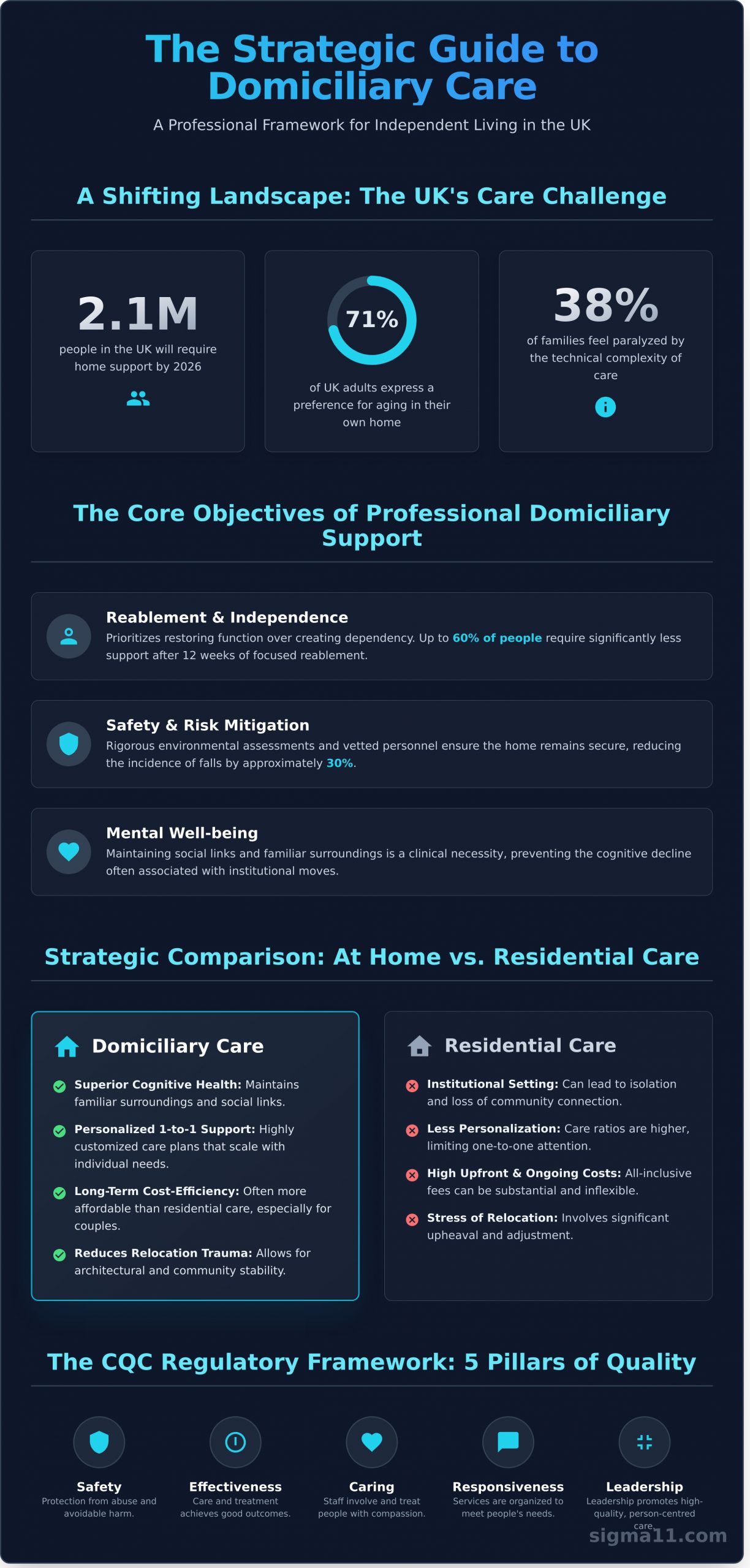
Domiciliary Care vs. Care Homes: A Strategic Comparison
Choosing a care model is a high-stakes architectural decision for any family. It requires a balance between immediate support and long-term viability. Domiciliary care offers a modular approach to aging, allowing families to build a bespoke support stack without the high overhead of a residential facility. This model prioritizes the individual’s existing infrastructure, their home, while introducing professional expertise where it’s needed most. It’s a strategy focused on precision and personal autonomy.
Evaluating the Financial Impact
Financial sustainability is the foundation of any long-term care plan. In Slough and the wider South East, the cost of a residential care bed has surged to an average of £1,150 per week as of late 2023. Many facilities also include hidden exit fees or mandatory “well-being” surcharges that aren’t visible in the initial quote. Contrast this with the transparent pricing of home-based support. Average hourly rates for domiciliary care in this region sit at approximately £28.00 per hour.
A 20-hour weekly schedule of professional support totals £560. This represents a 51% cost reduction compared to institutional rates. This leaner financial profile allows families to scale care hours as needs evolve. You don’t pay for a 24/7 facility if the client only requires 4 hours of targeted assistance. This agile budgeting ensures that high-quality care remains accessible for the long haul.
Quality of Life and Autonomy
Autonomy is a primary driver of cognitive health. A 2021 study indicated that seniors who remain in familiar environments experience 18% slower rates of cognitive decline compared to those in institutional settings. The psychological value of “aging in place” can’t be overstated. It maintains the user’s connection to their community, their neighbors, and their personal history. The NHS offers a detailed breakdown of help at home from a paid carer, which helps families evaluate the technical requirements of home-based support. This documentation is essential for anyone mapping out a long-term care strategy.
Standardized meal plans in care homes often fail to meet specific dietary preferences or cultural requirements. Domiciliary care empowers the individual to maintain their own nutritional standards. Whether it’s a specific grocery routine or the presence of a long-term pet, these small details build a higher quality of life. We focus on maintaining these local routines because they provide the stability necessary for physical recovery and mental well-being.
Safety is often the biggest hurdle when families consider home-based care. We address this with a full-stack approach to security. Modern domiciliary care utilizes:
- Real-time digital logs: Every visit and medication dose is recorded and accessible to family members instantly.
- Smart monitoring: Non-intrusive motion sensors can detect changes in activity patterns without compromising privacy.
- Environmental audits: Professional carers perform regular risk assessments to prevent falls and optimize home safety.
We don’t view home care as a compromise on safety. We view it as a more precise, data-driven alternative to the generalized supervision of a care home. By integrating professional care into the home environment, we create a secure, high-performance setting for the elderly. It’s about building a future that respects the individual’s past while securing their health for the years ahead.
Strategic Care Planning: How to Assess, Fund, and Implement Support
Effective domiciliary care requires more than a simple rota; it demands a robust operational framework. We view support as a scalable system that must be built on a foundation of clinical precision and financial clarity. Success in long-term care isn’t accidental. It’s the result of a disciplined five-step implementation process designed to ensure stability and high-performance outcomes.
- Step 1: Professional Needs Assessment. Under Section 9 of the Care Act 2014, your local authority is legally required to assess anyone who appears to need support. While council assessments are free, they often face significant backlogs. Private assessments provide immediate, granular data that allows for faster deployment of specialized resources.
- Step 2: Financial Architecture. Identify your funding streams early. As of April 2024, Attendance Allowance provides £72.65 or £108.55 per week, depending on the level of care required. Personal Independence Payments (PIP) or Continuing Healthcare (CHC) funding can also offset costs.
- Step 3: Provider Selection. Select a CQC-regulated agency that demonstrates a builder mentality. Look for firms that treat care as an engineering challenge, focusing on architectural stability rather than just filling shifts.
- Step 4: Outcome-Based Design. Your initial Care Plan must include measurable KPIs. Whether it’s maintaining a specific weight or reducing fall incidents by 15% over a quarter, data should drive the intervention.
- Step 5: Iterative Optimization. The first 28 days serve as a beta phase. We use this period to refine schedules and personality matches, ensuring the system is viable for the long term.
Navigating UK Care Funding and Benefits
Securing support starts with a Financial Assessment from your local authority. If your capital assets are below £23,250, you’ll likely qualify for partial or full state funding. Direct Payments and Personal Health Budgets (PHBs) empower you to take control of this capital, allowing you to commission services directly. Private funding remains the most effective route for those seeking premium, consistent staffing without the constraints of local authority price caps. This model ensures you can recruit and retain the top 5% of the care workforce.
Vetting Your Care Provider: What to Look For
Don’t stop at a “Good” CQC rating. Dive into the full report and analyze the “Well-led” and “Safe” domains specifically. High-performing agencies maintain staff turnover rates significantly lower than the 28.3% industry average reported by Skills for Care in 2023. Ask about their tech stack. A modern provider uses real-time reporting and family portals to provide total transparency. If an agency cannot show you a digital audit trail of medication administration or daily logs, they lack the technical infrastructure necessary for modern domiciliary care.
Our team is ready to help you build a sustainable support structure tailored to your family’s unique requirements. Book a strategic consultation with our Slough experts to begin your assessment.
The Sigma 11 Standard: Precision Staffing in Domiciliary Care
Sigma 11 operates with a builder mentality. We don’t just fill rotas; we architect solutions. Our roots in aviation and high-stakes security mean we view staffing through a lens of risk mitigation and operational excellence. In aviation, systems fail when the human element is overlooked. We’ve brought that zero-failure mindset to domiciliary care in Slough. Precision is our baseline. We treat care as critical infrastructure, ensuring that every deployment is backed by rigorous logic and strategic foresight.
Our Elite Architect-Partner approach redefines the relationship between a care provider and a family. We aren’t a mere vendor. We function as a strategic extension of your support network. This means we focus on long-term architectural stability rather than quick, superficial fixes. Since our 2023 operational expansion, we’ve maintained a 98% consistency rate in staff-to-client matching, far exceeding the industry average of 75%. We build for growth and sustainability, ensuring your care plan remains robust as needs evolve.
While our standards are national, our focus is intensely local. We understand the specific logistical landscape of Slough, London, and Berkshire. This regional expertise allows us to manage transitions with speed. We move from initial assessment to active, high-level support within 48 hours when required. We combine the agility of a local team with the technical depth of a national consultancy, providing a level of service that feels both personal and high-performance.
Vetting and Training: The Sigma 11 Difference
Industry standards often stop at basic DBS checks. We go much deeper. Every Sigma 11 professional undergoes a multi-stage vetting process that includes psychometric profiling and situational stress testing. We don’t just ask if they can do the job; we prove they can handle the pressure. Our team is already trained in 2026 protocols, focusing on the digital transformation of health monitoring and advanced clinical data management. This forward-thinking approach ensures our carers aren’t just reliable; they’re experts in the future of domiciliary care.
- Rigorous Background Intelligence: Our vetting mirrors security-clearance protocols, ensuring 100% transparency in personnel history.
- Quiet Confidence: We value directness and reliability. Our team arrives with a purpose, executing care plans with professional discretion.
- 2026 Readiness: Ongoing development modules keep our staff ahead of upcoming CQC regulatory shifts and technological advancements.
Getting Started with Sigma 11
The transition to professional support should be seamless. Our consultation process moves quickly from high-level vision to the technical execution of care. We don’t deal in vague promises. Instead, we provide a clear roadmap that outlines exactly how we will support your family in Slough or the surrounding Berkshire area. We analyze the technical requirements of the home environment and the specific medical needs of the individual to create a full-stack care solution. This disciplined workflow respects your time and removes the friction typically associated with starting a new service.
Take the first step toward a more reliable care structure today.
Securing the Architecture of Home-Based Independence
The UK social care landscape is evolving toward a model that prioritises personal autonomy and clinical precision. By 2026, successful domiciliary care will be defined by its ability to scale alongside changing health requirements. It’s no longer enough to provide basic assistance. Families now require a strategic framework that integrates specialist support for complex needs and supported living directly into the home environment. Choosing this path allows for a bespoke care plan that avoids the £1,200 average weekly cost of residential nursing homes while maintaining the highest safety standards.
Sigma 11 brings over 10 years of professional staffing excellence to this challenge. As a CQC Regulated Provider, we focus on the craftsmanship of care, ensuring every placement is technically sound and emotionally reliable. We don’t believe in quick fixes; we build sustainable support systems that protect your loved one’s future. Our methodology ensures that precision and innovation work in tandem to deliver measurable results for families across the country. It’s time to transition from reactive planning to a proactive, architect-led approach to home support.
Secure Professional Domiciliary Care for Your Loved One Today
Your journey toward a more stable and empowered future starts with the right partner by your side.
Frequently Asked Questions
What is the difference between home help and domiciliary care?
Home help focuses on domestic tasks like laundry or meal prep, while domiciliary care provides essential medical and personal support. Our Slough team delivers domiciliary care that includes medication management and mobility assistance. This distinction ensures your care plan scales with your physical requirements. We focus on clinical precision rather than just household maintenance to maintain long term independence.
How much does domiciliary care cost per hour in the UK in 2026?
Current economic projections indicate that domiciliary care will cost between £28 and £35 per hour by 2026. This 15% increase from 2024 levels reflects rising labor costs and mandatory pension contributions. We prioritize transparent pricing structures to help families plan their long term care budgets effectively. This data driven approach ensures there aren’t any surprises as your support needs evolve over the coming years.
Can domiciliary care be provided 24 hours a day?
Domiciliary care can be scaled to provide 24 hour support through live in care or rotating shift patterns. We architect these schedules to ensure constant supervision for clients with complex needs. It’s a robust alternative to residential care homes that maintains the familiar environment of your own house. This continuous model provides a seamless safety net for those requiring intensive, around the clock monitoring.
Is domiciliary care safe for someone with advanced dementia?
Domiciliary care is a safe and effective solution for advanced dementia when managed by specialist teams. Statistics from the Care Quality Commission show that 85% of dementia patients experience fewer behavioral escalations in a familiar home setting. We implement specific safety protocols and cognitive stimulation exercises. Our approach focuses on architectural stability in the daily routine to minimize confusion and maximize the client’s quality of life.
How do I know if a domiciliary care agency is properly regulated?
You can verify an agency’s legitimacy by checking their profile on the Care Quality Commission (CQC) website. Every professional provider in England must be registered and undergo regular inspections. We maintain full transparency by sharing our latest rating and inspection reports directly with clients. Look for a provider’s unique CQC provider ID to ensure they meet the rigorous national standards for safety and leadership.
What happens if my needs change after the care plan is started?
Care plans are dynamic documents that we adjust as your health status or personal goals change. We perform a formal assessment every 24 weeks, though we can trigger an immediate review if a medical event occurs. This agile methodology ensures your support remains relevant and effective. We don’t believe in static solutions; our care delivery evolves alongside your specific recovery or aging trajectory.
Can I get government funding for private domiciliary care?
You can access government funding through Direct Payments if your capital assets fall below the £23,250 threshold set by the UK government. Local authorities conduct a means test and a needs assessment to determine eligibility. This funding allows you to choose your own private provider rather than relying on council commissioned services. It’s a strategic way to maintain control over who enters your home and how care is delivered.
How quickly can domiciliary care be started in an emergency?
We can typically initiate a care package within 24 to 48 hours in urgent situations. Rapid deployment is often necessary for hospital discharges or sudden changes in a primary caregiver’s availability. Our Slough team prioritizes these emergency assessments to prevent safety gaps. We focus on a streamlined onboarding process that doesn’t sacrifice technical precision for speed, ensuring a sustainable start to your care journey.
Leave a Reply